
Two-Truck LED Billboard Campaign: Back-to-School Advertising That Follows Students Everywhere
How Boost Outdoor Media ran a two-truck mobile billboard campaign for TaskRabbit during Boston move-in week — and how to run the same play in any city in the country.
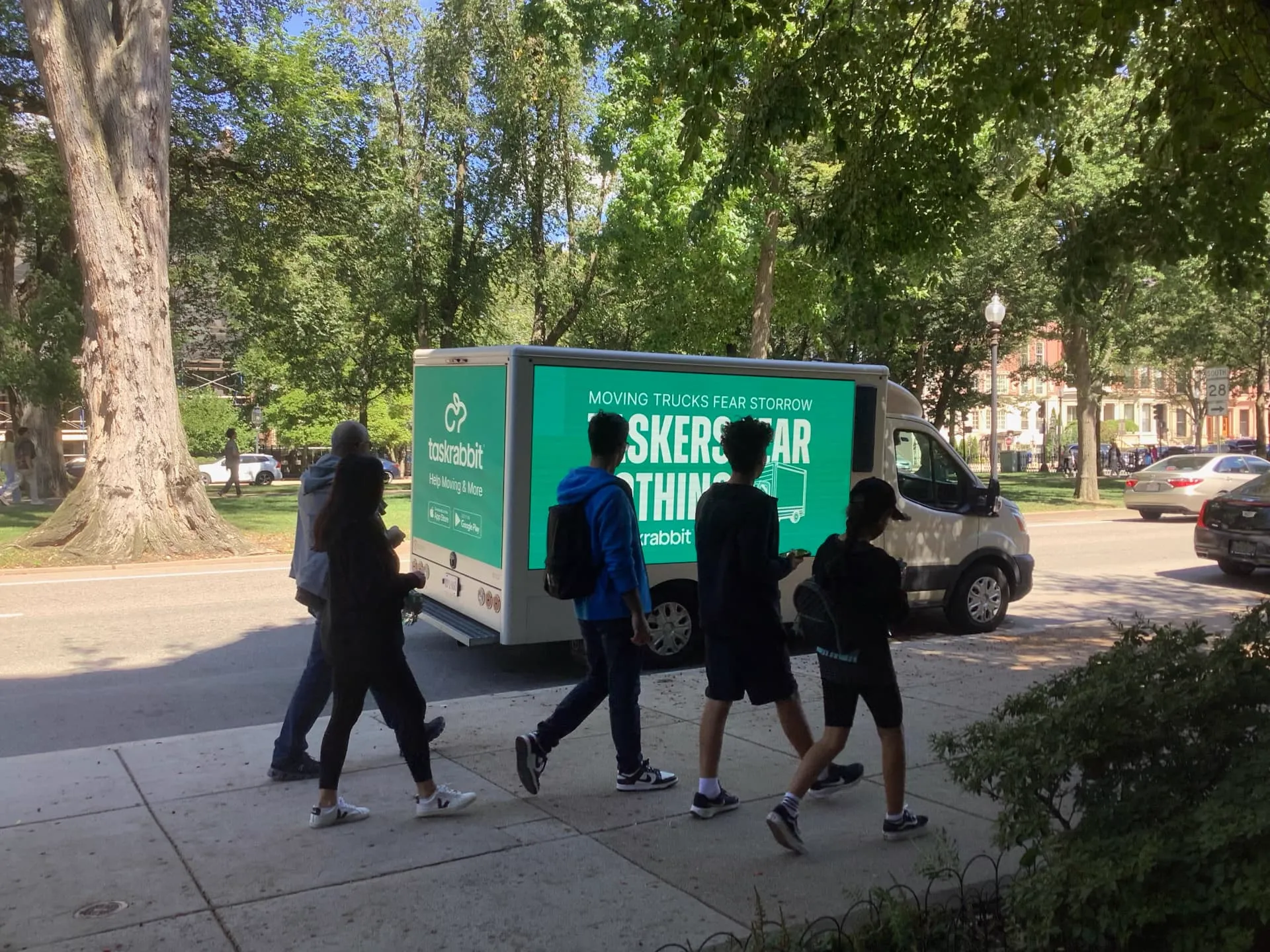
A two-truck LED billboard campaign covering campus and retail routes during Boston back-to-school move-in week.
Short answer: A two-truck LED billboard campaign doubles your back-to-school reach by covering two student corridors at the same time — one truck working campus move-in streets, the other circling retail and big-box shopping centers where parents buy dorm supplies. Boost Outdoor Media ran exactly this setup for TaskRabbit in Boston during move-in week, and the same two-truck structure works in any college town or metro in the country.
Truck one working the Commonwealth Avenue campus corridor, where thousands of students walk to class and move-in traffic backs up every September.
Why back-to-school is the best season for mobile billboard advertising
Back-to-school is a compressed, high-spend, geographically predictable moment. Families move into the same neighborhoods, shop at the same big-box stores, and travel the same congested roads during a two-to-three week window. That combination is ideal for LED billboard truck advertising: you do not need citywide coverage, you need saturation of a handful of streets at the exact hours people are on them.
Static billboards cannot do this. A fixed board sells you a 4-week contract on one location. A mobile billboard truck lets you buy the days that matter and move between campus, retail, and event traffic in a single shift.
The campaign: two trucks, two jobs
The TaskRabbit message — "Moving trucks fear Storrow. Taskers fear nothing." — was written for Boston infamous Storrow Drive move-in truck crashes. The creative was local, funny, and instantly readable at a stoplight. The media plan split two LED trucks into two distinct roles:
- Truck one — campus corridor. Commonwealth Avenue, Boston University, Northeastern, Fenway, and the Storrow Drive approaches. Peak exposure to students, parents, and rental trucks during the move-in window.
- Truck two — retail and supply run. The Fenway Target, Boylston Street, and the shopping blocks where parents stock dorm rooms. This is where the buying decision actually happens.
Running both at once meant a family could see the ad on the drive in, again in the Target parking lot, and again on the walk back. Frequency inside one day is what makes two trucks outperform two separate one-truck weeks.
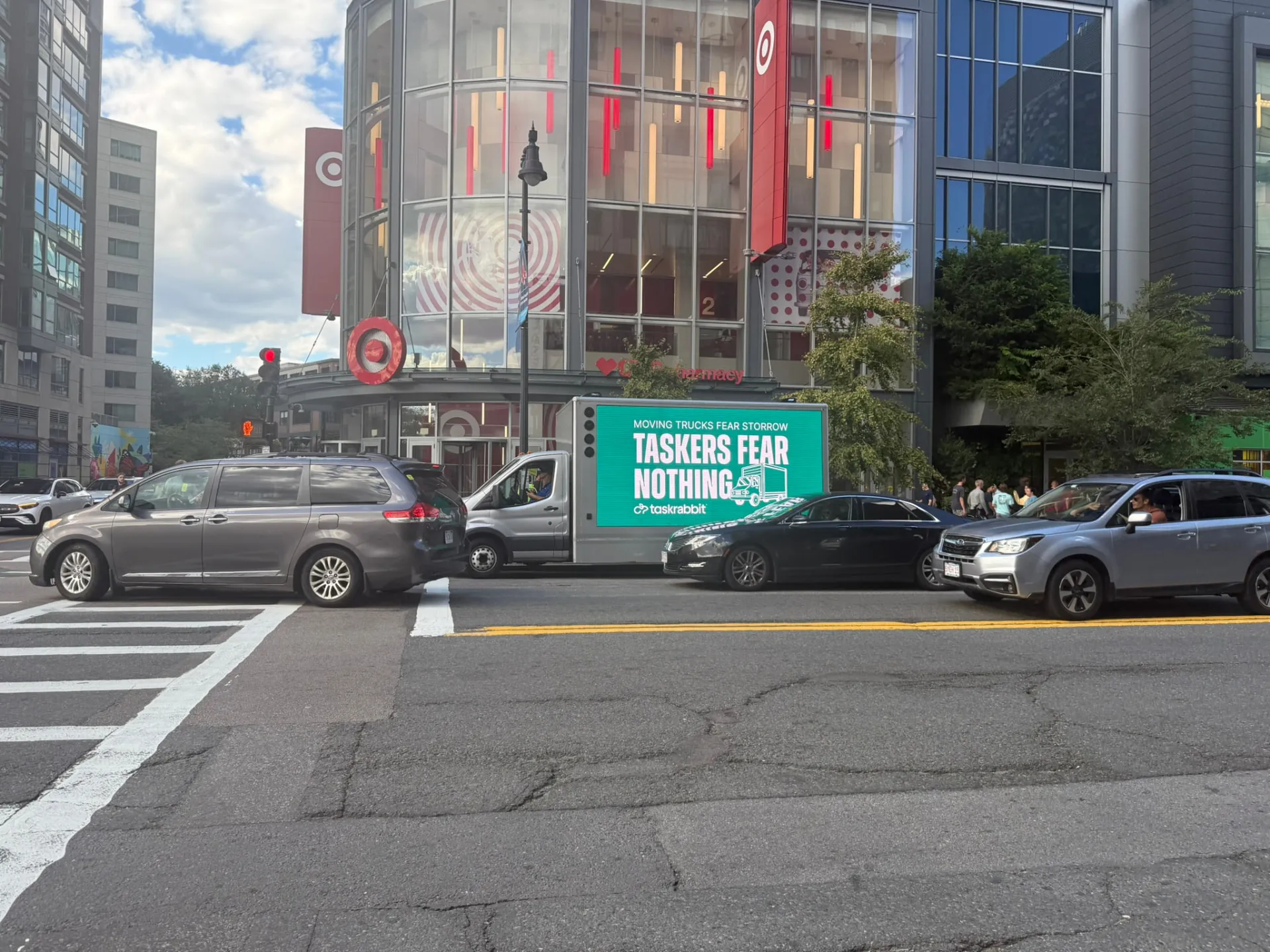
Truck two holding the intersection outside the Fenway Target — the exact spot parents load up on dorm supplies during back-to-school week.
Route strategy you can copy in any city
Every college metro has the same four ingredients. Map yours before you book:
- The move-in artery. The one road every rental truck uses to reach campus housing. In Boston it is Storrow Drive and Comm Ave; in Austin it is Guadalupe; in Columbus it is High Street.
- The supply retail cluster. Target, Walmart, and grocery anchors within three miles of campus.
- The pedestrian crossing. A light-controlled intersection with heavy foot traffic where the screen sits stationary for 30–60 seconds per cycle.
- The evening event. Orientation nights, welcome-week concerts, first home football game, bar districts on the first weekend.
A two-truck plan assigns items 1 and 3 to one truck, 2 and 4 to the other, then swaps them on the second day so both audiences get repeated exposure from different angles.
Nationwide back-to-school advertising, not just Boston
Boost Outdoor Media runs mobile billboard advertising across the country, so a back-to-school program does not have to be one market. Brands commonly run three to six campus metros in the same two-week window — Boston, Charlotte, Indianapolis, Raleigh, Hartford, Providence, Portland, Austin — with the same creative and locally adjusted routes. Because LED screens are digital, each city can also swap in a local line at no production cost.
If you are planning a national back-to-school campaign, the practical sequence is: pick the metros by student population, book the move-in dates first (they are fixed and they sell out), then layer retail routes around them.
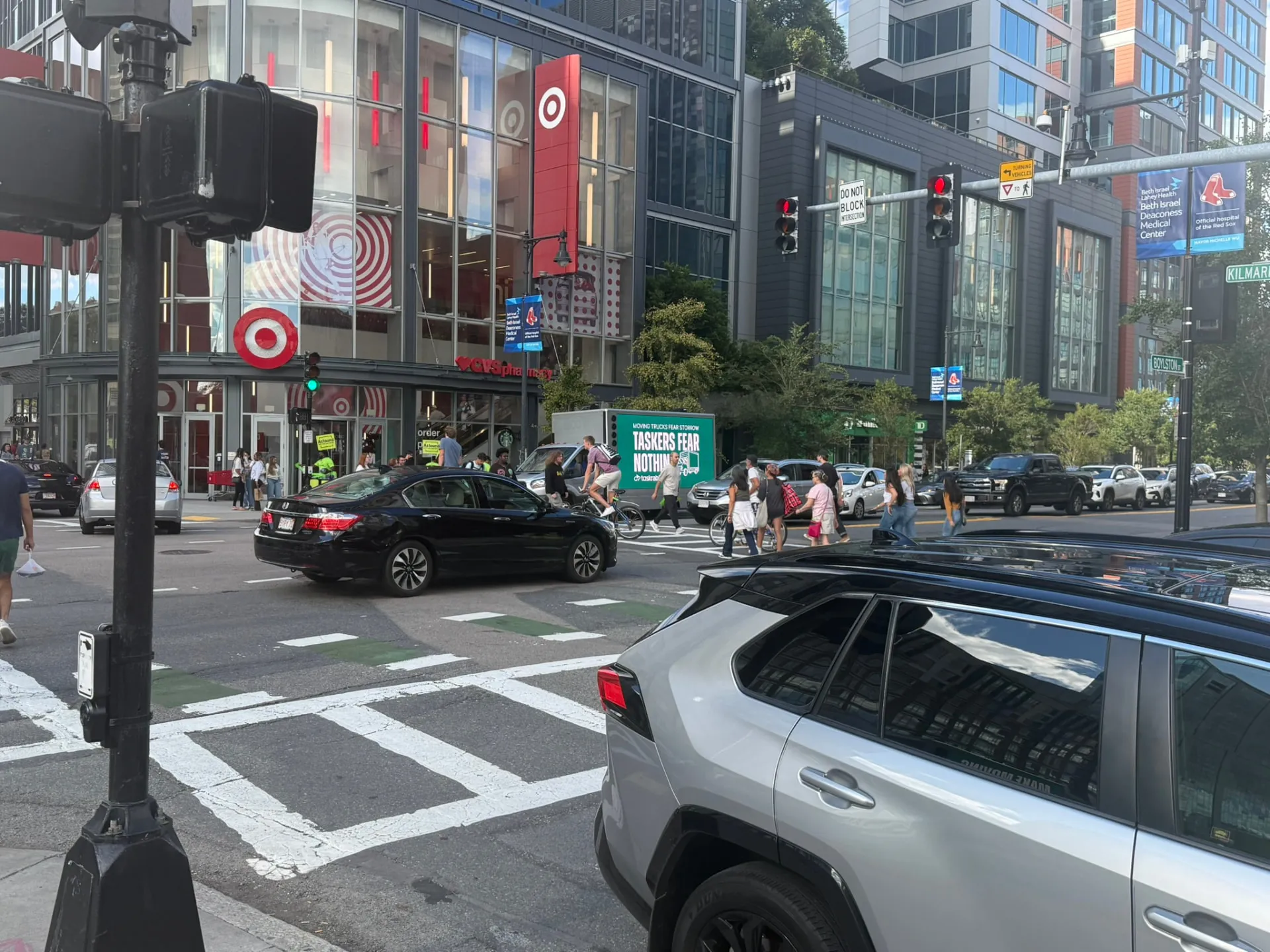
Boylston Street at rush hour: pedestrians, cyclists, and stopped cars all see the same screen during a single light cycle.
What a two-truck back-to-school campaign costs
Boost Outdoor Media prices LED billboard trucks at roughly $1,200 to $1,400 per truck per day for a standard 6–8 hour shift, with lower per-day rates on multi-day and multi-truck bookings. A two-truck, three-day back-to-school push therefore typically lands in the $6,500–$8,000 range for a single metro, including routing, a driver, and daily photo and GPS reporting.
| Setup | Typical spend | Best for |
|---|---|---|
| One truck, one day | $1,200–$1,400 | Single event, grand opening, game day |
| One truck, three days | $3,300–$3,900 | One campus, move-in week |
| Two trucks, three days | $6,500–$8,000 | Campus plus retail saturation |
| Multi-market, two weeks | Custom | National back-to-school programs |
Creative rules for student audiences
Back-to-school viewers are walking, driving, or distracted. The creative that worked here followed four rules: seven words or fewer in the headline, a local in-joke that rewards residents, a logo large enough to read at 100 feet, and a single brand color that owns the street. No QR codes, no phone numbers, no paragraphs.
Book a back-to-school LED truck campaign
Boost Outdoor Media plans routes, handles permitting questions, provides the driver, and sends daily proof-of-play photos and GPS logs. See mobile LED billboard advertising, review mobile billboard advertising costs, or check the cities we serve. Call 978-288-1616 or request a quote to lock in move-in week dates before they sell out.
Frequently asked questions
How much does a two-truck LED billboard campaign cost?
Boost Outdoor Media charges roughly $1,200 to $1,400 per truck per day for a 6-8 hour shift. A two-truck, three-day back-to-school campaign in one metro typically runs $6,500 to $8,000, including routing, driver, and daily photo and GPS reporting. Multi-day and multi-truck bookings get lower per-day rates.
Why use two LED billboard trucks instead of one?
Two trucks let you cover two different audiences at the same time - one on campus move-in streets and one at the retail centers where parents buy dorm supplies. That produces repeat exposure within a single day, which drives recall far better than one truck covering twice the ground over two days.
Can I run a back-to-school billboard truck campaign outside Boston?
Yes. Boost Outdoor Media runs mobile billboard advertising nationwide, including Charlotte, Raleigh, Indianapolis, Austin, Hartford, Providence, and Portland. Brands frequently run the same creative in three to six college metros during the same two-week move-in window, with routes adjusted locally.
When should I book a back-to-school LED truck campaign?
Book six to eight weeks ahead. College move-in dates are fixed and concentrated in mid-August through early September, so trucks in major campus metros sell out first. Retail-focused dates around the same window are easier to secure late.
What should back-to-school billboard truck creative say?
Keep the headline to seven words or fewer, use one dominant brand color, make the logo readable from 100 feet, and add a local reference if you have one. Skip QR codes and phone numbers - viewers are walking or driving and will not act on small details.
How do I know the trucks actually ran my routes?
Boost Outdoor Media sends daily proof-of-play photos and GPS route logs for every truck and every shift, so you can confirm the LED billboard truck covered the campus corridors, retail centers, and events agreed to in the media plan.