
Recruitment Advertising With LED Billboard Trucks: Hiring Hourly and Healthcare Workers
How employers fill warehouse, manufacturing, nursing and medical device roles by driving a hiring message straight to where candidates already are
Short answer: A mobile LED billboard truck is one of the fastest ways to fill hourly and healthcare roles because it puts a legible "Now Hiring" message with a phone number or QR code directly in front of people during shift change, at grocery plazas, and outside competing employers. Boost Outdoor Media runs recruitment routes nationwide for roughly $1,200 to $1,400 per truck per day.
Why recruitment advertising works better on wheels
Hourly candidates are rarely browsing job boards at a desk. They are commuting, shopping, dropping kids off, or walking out of a shift. An LED billboard truck reaches them in those moments. Unlike a static billboard, the truck can be repositioned hour by hour to follow the crowd, and unlike digital ads, there is nothing to scroll past.
Three details make recruitment creative work on a truck: a two-word headline ("Now Hiring"), the pay rate, and one way to respond. Everything else is noise at 35 mph.
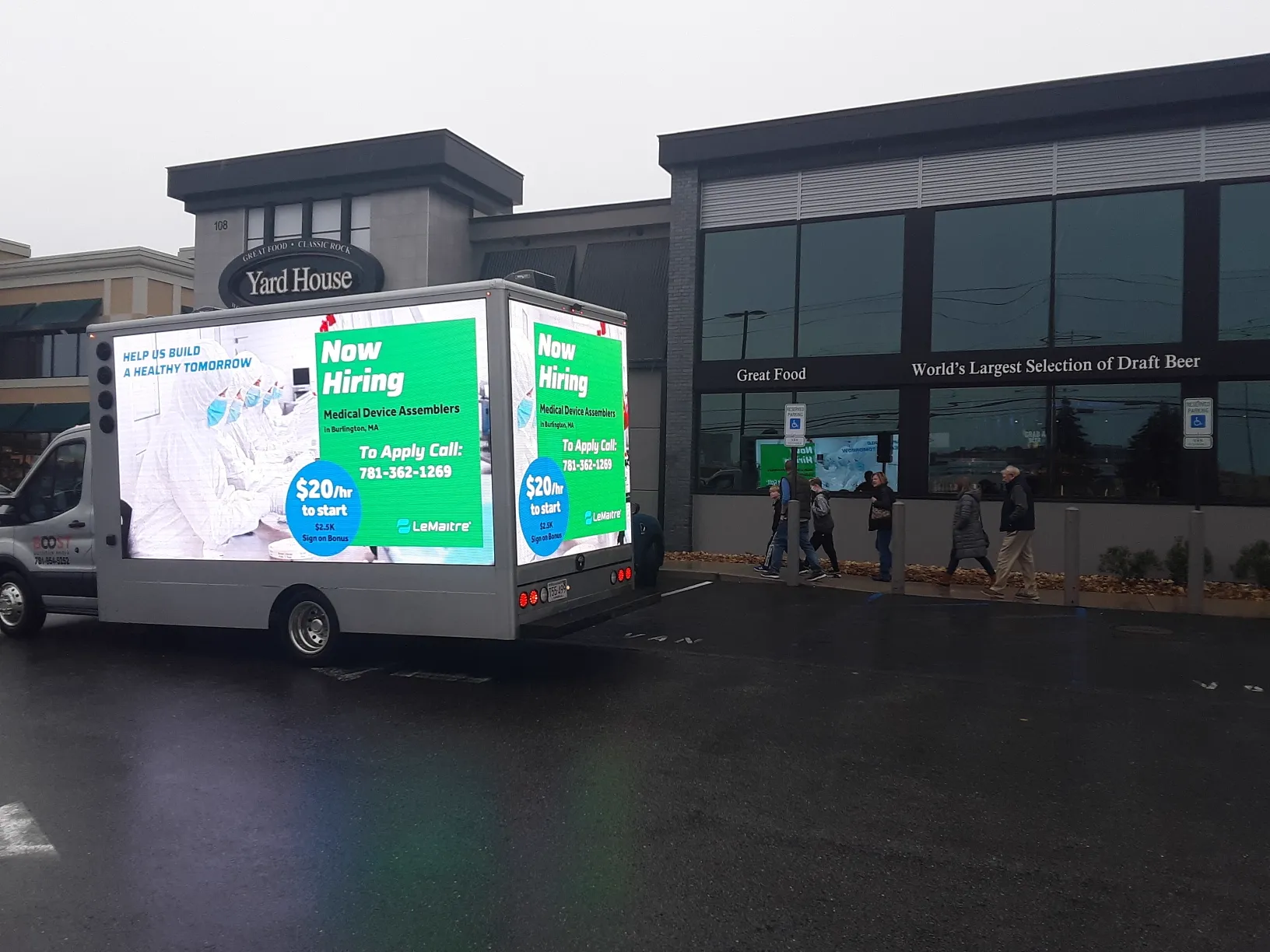
LeMaitre recruitment campaign: a Boost Outdoor Media LED billboard truck posted outside the Burlington Mall dining plaza, advertising medical device assembler roles at $20/hr with a $2.5K sign-on bonus.
Hourly hiring: warehouse, manufacturing, retail and food service
For hourly roles, pay rate is the headline. Campaigns that show the number ("$22/hour+", "$2,500 sign-on bonus") consistently out-pull campaigns that lead with a company logo. Route the truck to where hourly workers concentrate: distribution parks at shift change (6 a.m., 2 p.m., 10 p.m.), grocery plazas on weekend afternoons, transit hubs, and the parking lots of employers with the same labor pool.
A typical hourly recruitment route covers 20 to 40 miles a day across three or four clusters, holding position for 30 to 60 minutes at each high-dwell stop rather than driving constantly.
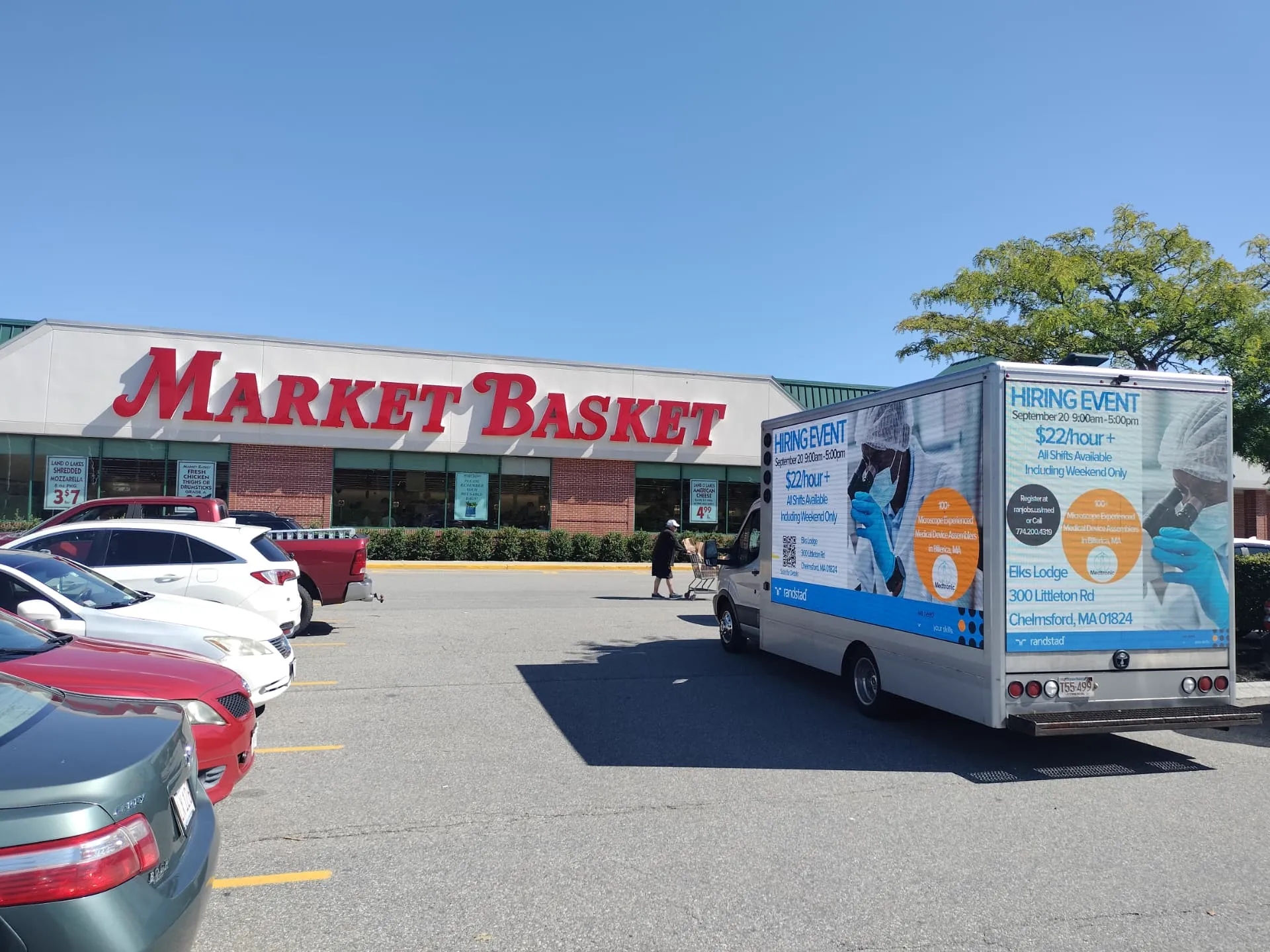
Randstad and Medtronic hiring event: the LED billboard truck parked at the Market Basket entrance in Chelmsford, MA, where grocery foot traffic delivers exactly the local hourly workforce the client was recruiting.
Healthcare recruitment: nurses, techs and allied health
Healthcare hiring is a different problem. Nurses, behavioral health staff, ED techs and telemetry staff are usually employed already, so the ad is a poaching message, not a discovery message. That changes the routing: park near the hospitals and medical office parks where those professionals already work and eat, time the truck to 7 a.m. and 7 p.m. shift changes, and lead with the differentiator that makes someone switch — schedule flexibility, float pool premiums, or an on-site hiring event with same-day offers.
On-site hiring events pair especially well with a truck. A date, a time and a URL on a ten-foot screen circling the right neighborhood for three days before the event produces walk-in volume that a job posting will not.
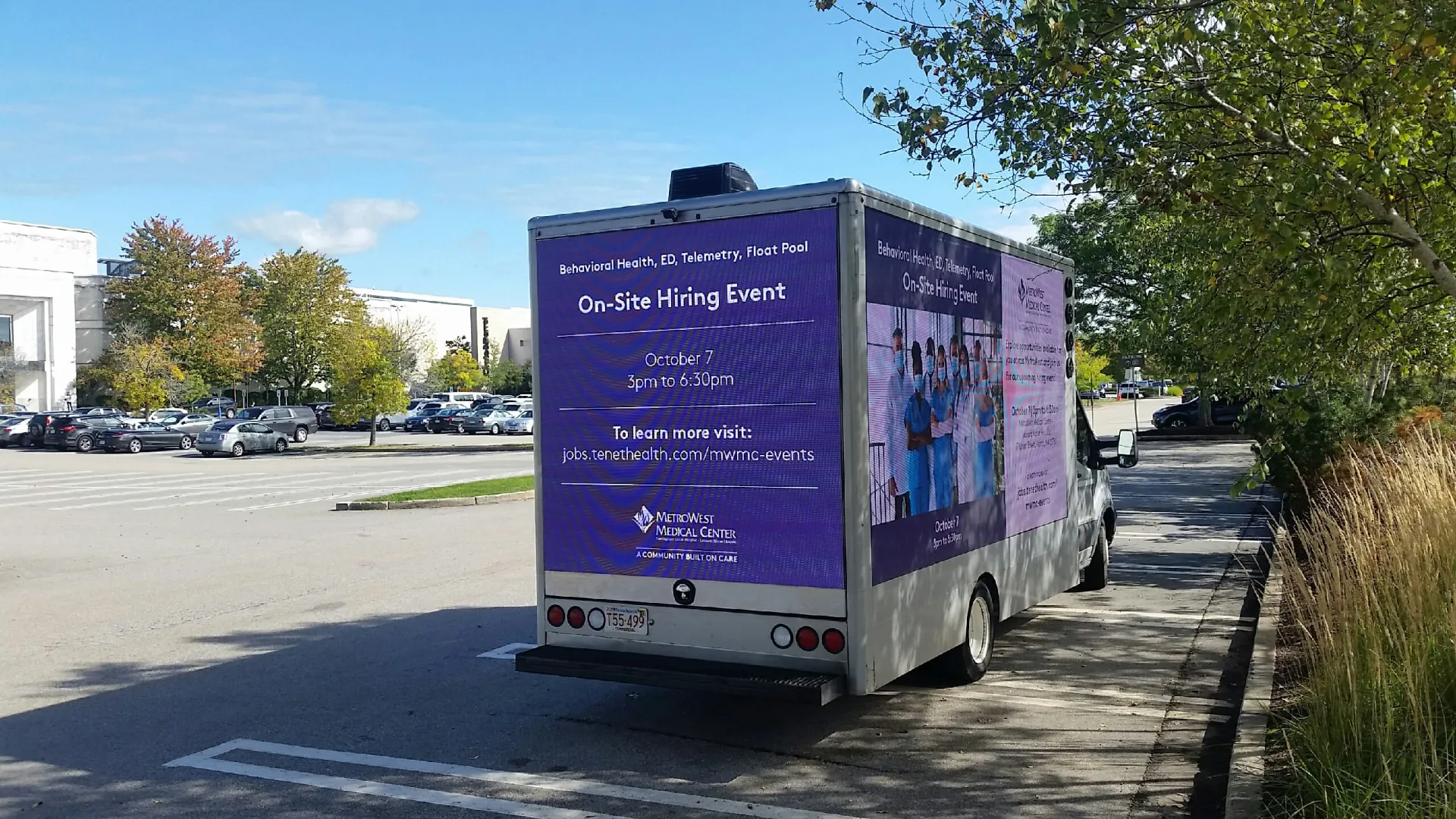
MetroWest Medical Center on-site hiring event promoted by LED billboard truck across Framingham, MA medical and retail corridors in the days leading up to the October event date.
Industries that hire this way
- Medical device and biotech manufacturing — assemblers, microscope techs, cleanroom operators
- Hospitals and health systems — RNs, LPNs, CNAs, behavioral health, ED, telemetry, float pool
- Staffing and RPO agencies — high-volume requisitions with tight fill deadlines
- Warehouse, logistics and 3PL — pickers, packers, forklift operators, CDL drivers
- Food service, hospitality and retail — seasonal surges and new-store openings
- Skilled trades and home services — HVAC, plumbing, electrical apprenticeships
- Senior living and home health — caregivers and aides in dense residential markets
What recruitment campaigns cost
| Campaign | Typical setup | Investment |
|---|---|---|
| Single hiring event push | 1 truck, 2-3 days | $2,400 - $4,200 |
| Ongoing hourly requisition | 1 truck, 5 days/week | $6,000 - $7,000 per week |
| Multi-site health system | 2 trucks, 3-5 days | $7,200 - $14,000 |
Rates run about $1,200 to $1,400 per truck per day and include the driver, the route plan, fuel, and the LED screens on all sides. Artwork can be supplied or designed by our team.
Measuring recruitment results
Use a dedicated phone number or a QR code that lands on a campaign-specific application page so every applicant is attributable. Compare cost per applicant against your job board spend — on high-volume hourly requisitions, truck campaigns frequently beat paid job boards because the audience is local by definition and there is no bidding war for impressions.
Run a recruitment campaign in your market
Boost Outdoor Media runs mobile LED billboard recruitment campaigns nationwide, from single hiring events to ongoing weekly routes. See full pricing on our mobile billboard advertising cost guide, browse the markets we serve, or call 978-288-1616 to map a route around your facilities.
Frequently asked questions
How much does recruitment advertising on an LED billboard truck cost?
A mobile LED billboard truck runs about $1,200 to $1,400 per truck per day, which includes the driver, route planning, fuel and the LED screens. A two to three day hiring event push typically costs $2,400 to $4,200, and an ongoing five-day-per-week hourly recruiting route runs about $6,000 to $7,000 per week.
Do billboard trucks actually work for hiring hourly employees?
Yes. Hourly candidates are commuting, shopping and finishing shifts rather than browsing job boards, so a truck parked at a grocery plaza or a distribution park at shift change reaches them directly. Campaigns that lead with the pay rate and a single response method, such as a phone number or QR code, generate the most applicants.
How do you recruit nurses and healthcare staff with a mobile billboard?
Healthcare recruiting is a competitive-switch message, so the truck is routed to hospitals, medical office parks and the neighborhoods where clinicians live, and timed to 7 a.m. and 7 p.m. shift changes. The creative leads with the reason to switch, such as schedule flexibility, float pool premiums or an on-site hiring event with same-day offers.
Can an LED billboard truck promote an on-site hiring event?
Yes, and it is one of the strongest uses. Running a truck through the target area for two to three days before the event, showing the date, time and registration URL, drives walk-in volume that a job posting alone rarely produces. Boost Outdoor Media has run this exact format for hospitals and staffing agencies.
Which industries use billboard trucks for recruitment?
Medical device and biotech manufacturing, hospitals and health systems, staffing and RPO agencies, warehouse and logistics operators, food service and retail, skilled trades, and senior living and home health providers all use LED billboard trucks for high-volume and hard-to-fill hiring.
How do you track applicants from a billboard truck campaign?
Use a dedicated phone number or a QR code pointing to a campaign-specific application page so every applicant is attributable to the truck. Cost per applicant can then be compared directly against job board spend, which truck campaigns often beat on high-volume local hourly requisitions.