
Case Study: How a Multi-Truck Mobile LED Billboard Campaign Covered All of Middlesex County
Marian Ryan for Middlesex District Attorney — 2026 Democratic Primary
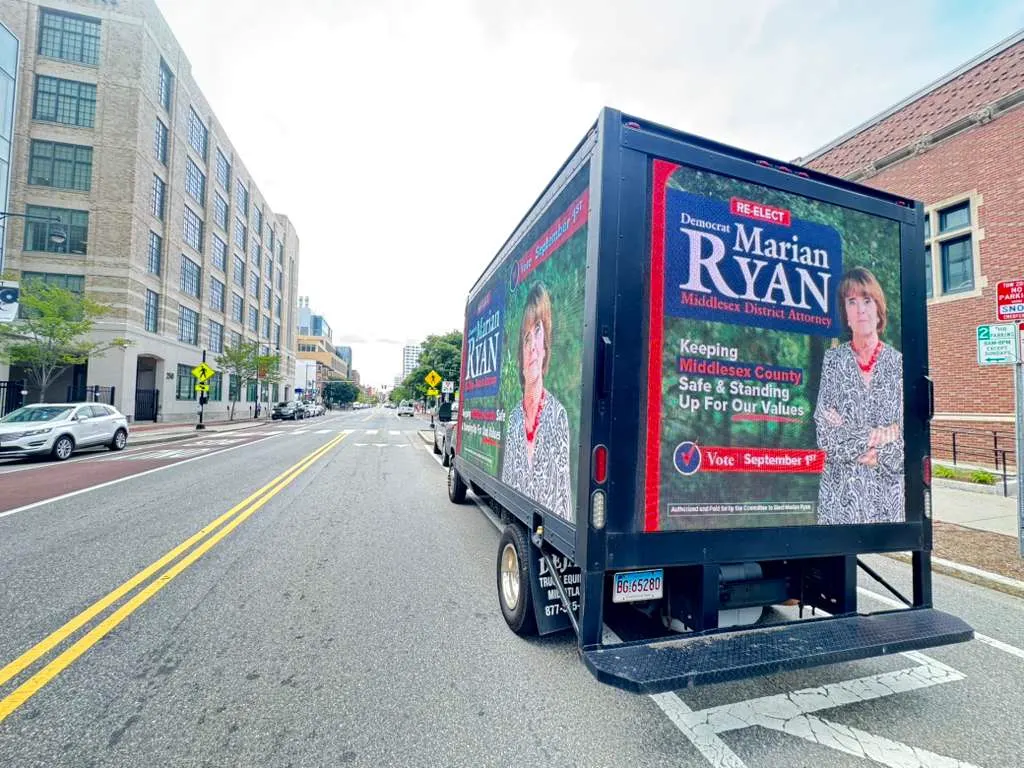
A Boost Outdoor Media mobile LED billboard truck carrying the Marian Ryan campaign creative through a Middlesex County commuter street.
Short answer: Boost Outdoor Media deployed multiple mobile LED billboard trucks at the same time across eight priority Middlesex County communities — Lowell, Cambridge, Newton, Somerville, Medford, Framingham, Belmont and Wayland — during the run-up to the September 1, 2026 Democratic primary for Middlesex District Attorney. Marian Ryan won the primary with 59,270 votes out of 79,549 nonblank District Attorney votes in those covered communities, a 74.5% combined share.
The challenge: cover a large district without spreading the message thin
Middlesex County is the largest county in Massachusetts by population, and it is not one audience. It contains dense urban centers like Cambridge and Somerville, mid-size cities like Lowell and Framingham, affluent suburbs like Newton, Belmont and Wayland, plus commuter corridors and big-box retail districts in between.
A single static billboard reaches one intersection. One mobile billboard truck trying to cover an entire county spends most of the day driving between towns instead of being seen. The campaign needed frequency in specific communities during the final stretch of the primary — not a slow rotation through the district.
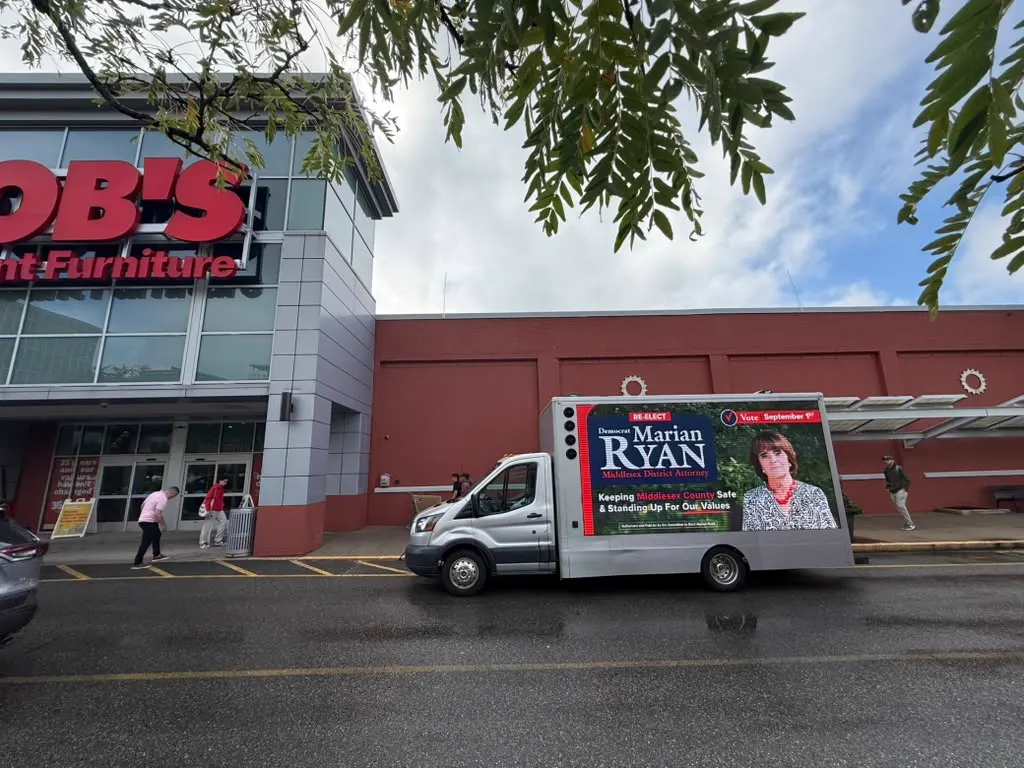
Retail parking lots put the mobile LED billboard in front of voters who were already out shopping — one of the highest-dwell environments in political outdoor advertising.
The strategy: parallel deployment instead of one long route
Instead of treating Middlesex County as one giant route, Boost Outdoor Media used parallel deployment: multiple LED billboard trucks operating in different communities during the same campaign period, all running identical creative.
That single decision changes the math of a mobile billboard campaign. Frequency — how many times one voter sees the message — matters more in the last two weeks of a primary than raw reach. Parallel trucks let the campaign hold local presence in several towns at once instead of trading one town for another each day.
Why parallel deployment beats a single truck across a county
| Factor | One truck, whole county | Multiple trucks, parallel |
|---|---|---|
| Daily community coverage | 1–2 towns | 4+ towns simultaneously |
| Time spent in transit | High — hours between markets | Low — each truck works one local grid |
| Repeat exposure per voter | Low, spread across days | High, same voter sees it in multiple contexts |
| Flexibility near Election Day | Must choose one priority town | Can surge several priority towns at once |
Field execution: put the message into the daily flow of each community
Routes were not random loops. Each truck worked a local grid built around where visibility is strongest: major signalized intersections, downtown retail streets, grocery and big-box plazas, gas stations on commuter approaches, transit stations and heavily traveled local corridors.
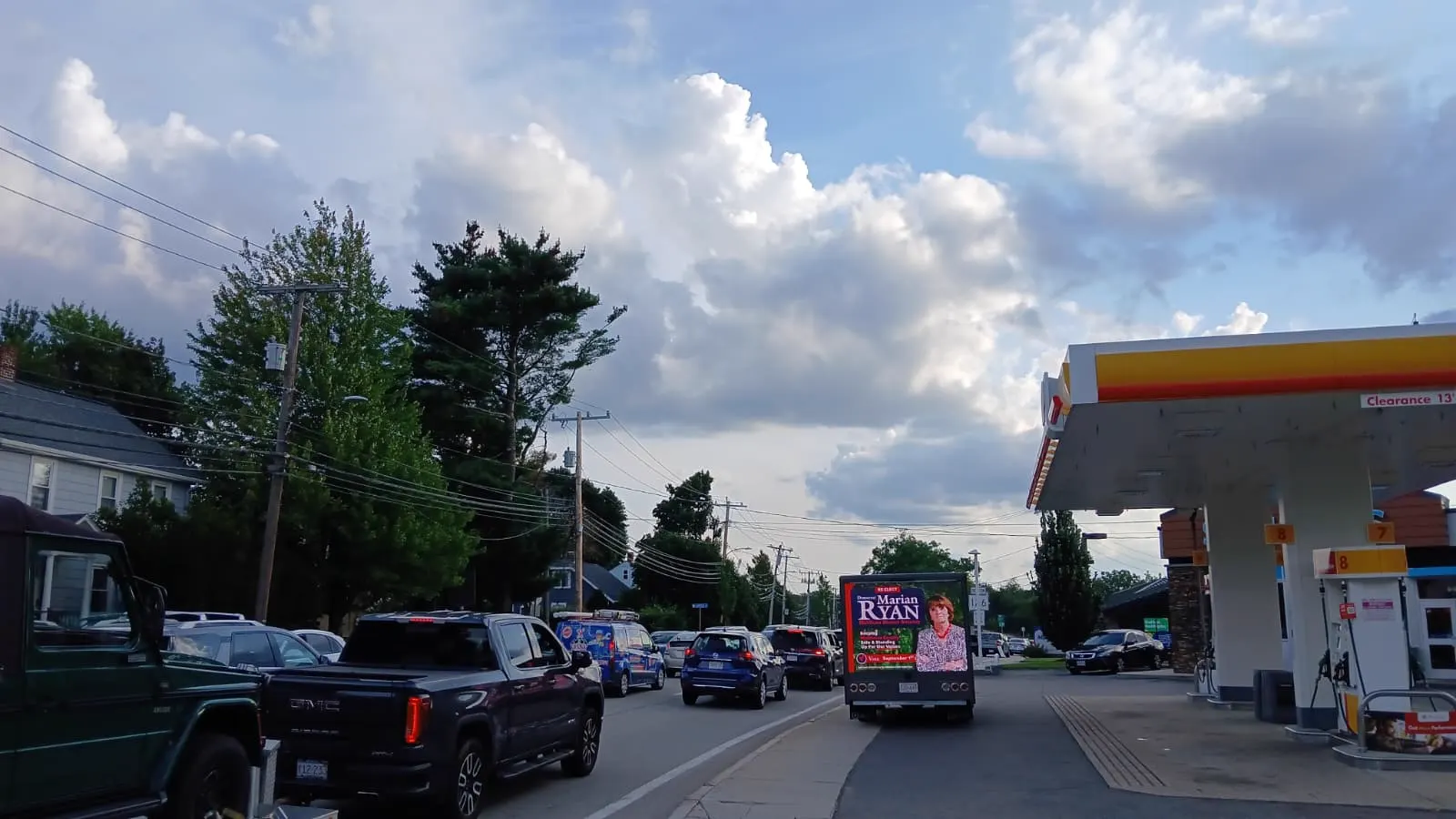
Evening commuter corridors and gas station approaches deliver slow-moving traffic — the ideal condition for a mobile billboard truck to be read, not glanced at.
Mobility changed the media plan
Traffic patterns are not static. A construction detour, a high school football game, a farmers market or an unusually busy Saturday retail block can move where the audience actually is. A mobile LED billboard truck can reposition within minutes. A fixed board cannot.
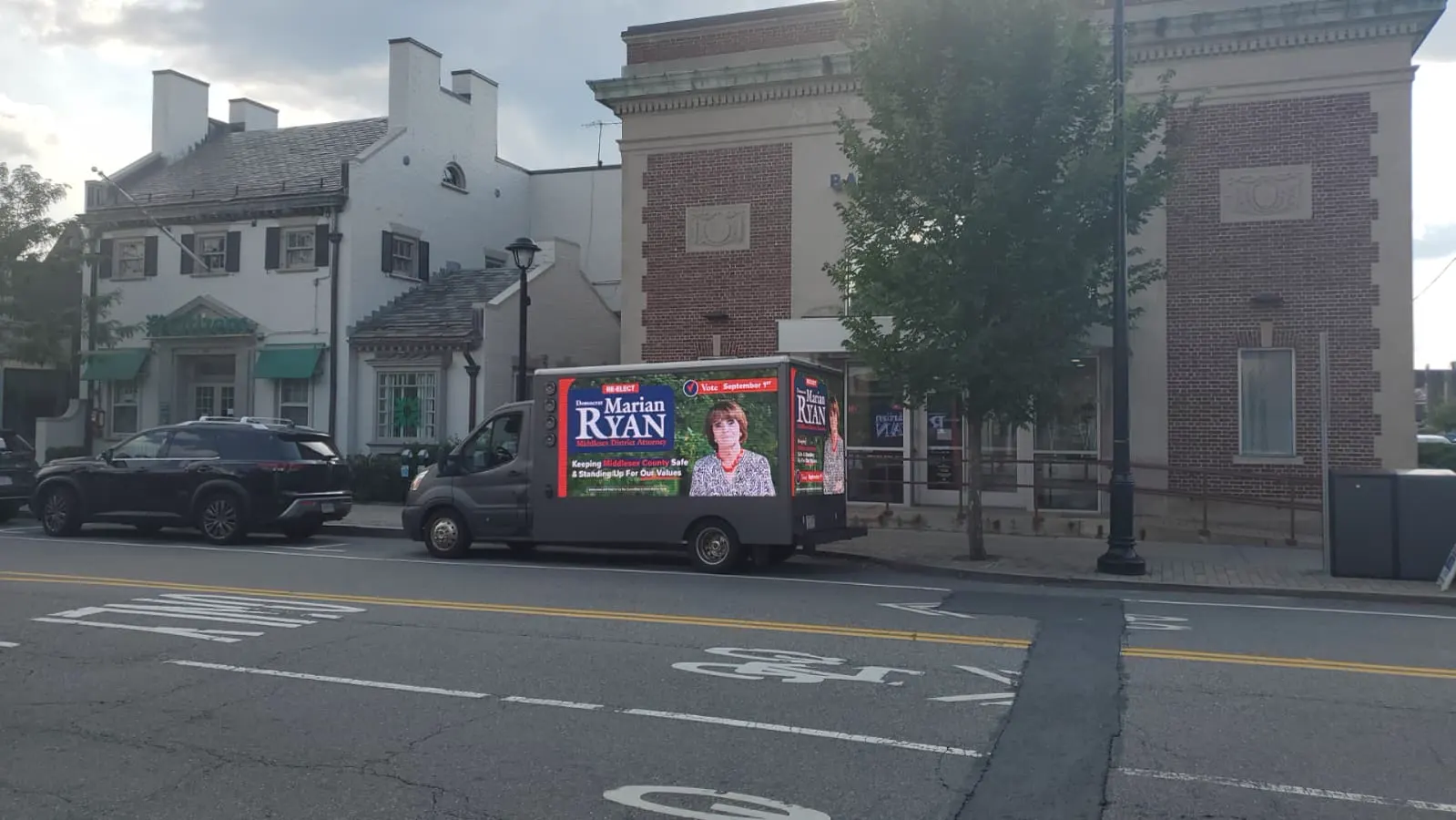
Downtown main streets in towns like Belmont and Newton concentrate foot traffic, local business owners and high-propensity primary voters in a few blocks.
Creative rules that made the LED truck work
Political mobile billboard creative has roughly three seconds to land. The Marian Ryan creative followed the rules that consistently perform on a 10-foot LED screen:
- Candidate name at maximum size. "RYAN" was legible from several car lengths back.
- Office stated plainly. "Middlesex District Attorney" — down-ballot races live or die on voters knowing what office is at stake.
- One message, not three. "Keeping Middlesex County Safe & Standing Up For Our Values."
- The date, always. "Vote September 1st" appeared on every panel, on every truck.
- Full-color candidate photo. Faces outperform logos in outdoor recall.
- Identical creative across all trucks. Consistency is what turns multiple impressions into one memory.
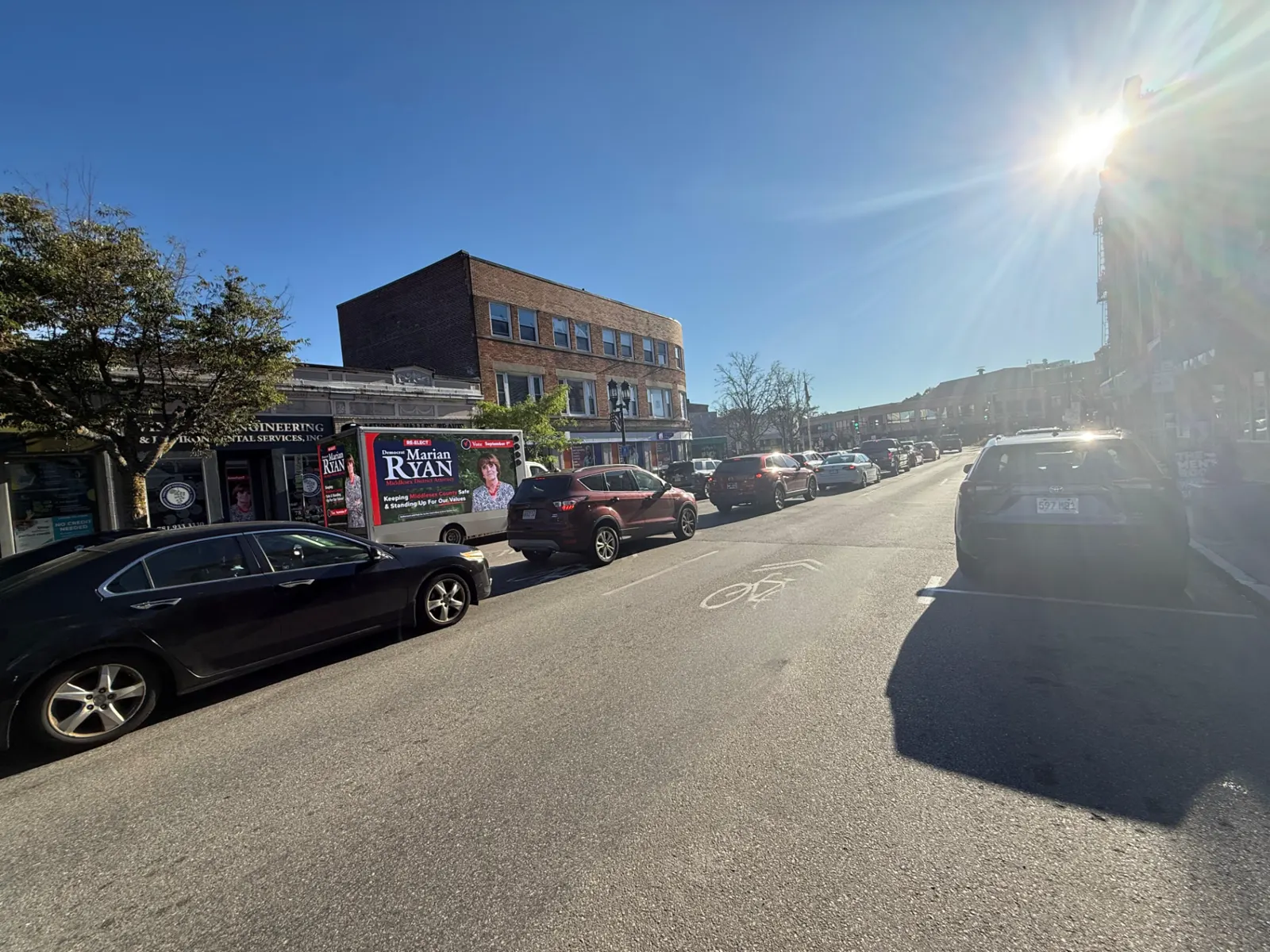
Identical creative on every truck meant a voter who saw the ad in two towns in one day registered it as repetition, not as two separate campaigns.
Community-level results in the eight covered towns
On September 1, 2026, Marian Ryan won the Democratic primary for Middlesex District Attorney. Across the eight communities where the mobile LED billboard trucks operated, Ryan took 59,270 of 79,549 nonblank District Attorney votes — a combined 74.5% share.
| Community | Total DA votes | Marian Ryan votes | Ryan share |
|---|---|---|---|
| Lowell, MA | 7,573 | 5,953 | 78.61% |
| Cambridge, MA | 17,458 | 11,800 | 67.59% |
| Newton, MA | 14,753 | 10,550 | 71.51% |
| Somerville, MA | 14,579 | 10,808 | 74.13% |
| Medford, MA | 9,090 | 7,092 | 78.02% |
| Framingham, MA | 8,520 | 6,893 | 80.90% |
| Belmont, MA | 5,247 | 4,336 | 82.64% |
| Wayland, MA | 2,329 | 1,838 | 78.92% |
Note: "Total DA votes" means nonblank votes cast in the Democratic District Attorney contest (Ryan, Solet and write-ins). Ryan share = Ryan votes divided by total nonblank DA votes. Figures come from municipal election-result postings after the September 1, 2026 primary; certification status varied by community at the time of compilation.
An honest caveat: advertising alone does not decide an election. Marian Ryan entered the race as a strong incumbent with campaign staff, volunteers, endorsements and direct voter contact. Mobile LED billboards were one visible layer on top of that work. What this case study demonstrates is coverage and execution, not causation.
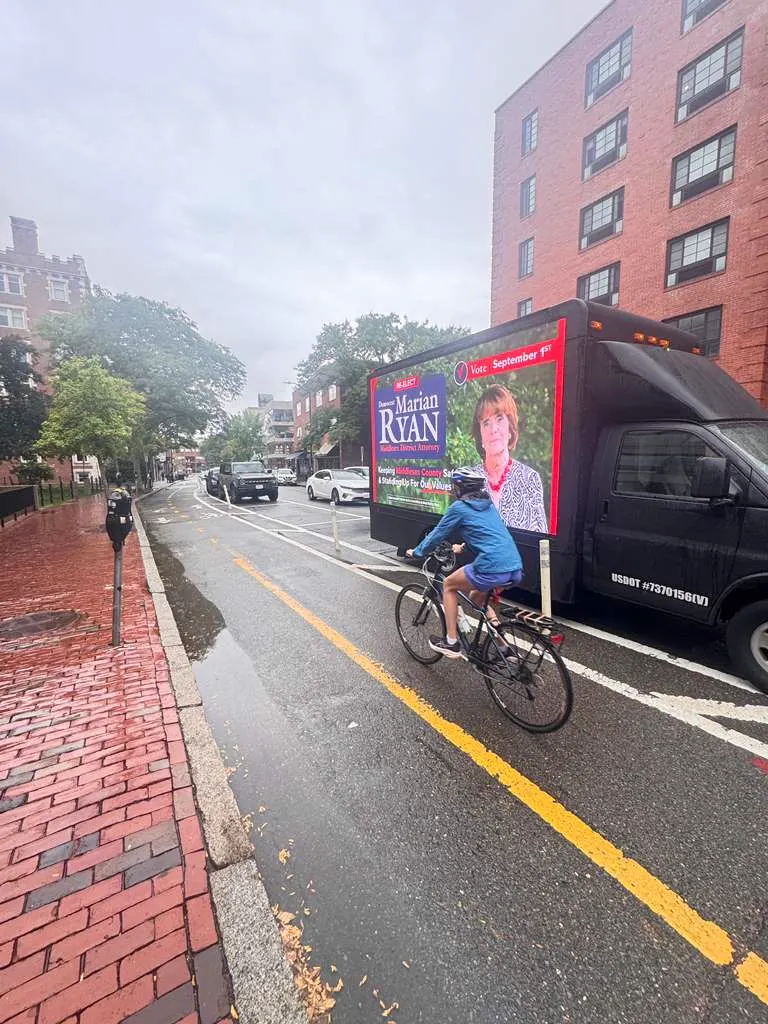
Rain on primary day did not stop the screen — LED billboard trucks stay fully legible in overcast, wet and low-light conditions when static vinyl washes out.
What campaigns in other counties can take from this
The Middlesex playbook transfers to any multi-municipality race — county prosecutor, county commissioner, state senate, congressional districts, statewide primaries and ballot questions.
- Rank your towns by vote yield, not by size. Belmont delivered 5,247 DA votes; the truck hours there were not wasted because turnout propensity was high.
- Run trucks in parallel for the final 7–14 days. That is when persuasion converts to turnout.
- Build local grids, not county loops. Every mile between towns is a mile no voter sees.
- Lock creative before deployment. One design across every vehicle.
- Always carry the election date. Down-ballot voters skip races they do not recognize.
Work with Boost Outdoor Media on your campaign
Boost Outdoor Media plans and runs political mobile LED billboard campaigns across Massachusetts, New Hampshire and the Northeast, with national coverage available for battleground races. If you are budgeting a race, start with our mobile billboard advertising cost guide, review how mobile LED billboard trucks work, or see our market coverage. Ready to talk routes and dates? Request a quote and we will build a community-by-community plan for your district.
Frequently asked questions
How much does a multi-truck mobile billboard campaign cost for a county race?
Mobile LED billboard trucks typically run about $1,200 to $2,000 per truck per day in the Boston and Middlesex County market, with lower daily rates on multi-day and multi-truck bookings. A two-week, three-truck push across a county district usually lands in the $30,000 to $60,000 range depending on hours per day and how many communities you cover. Boost Outdoor Media quotes by district, day count and route plan rather than by impression estimate.
Is mobile billboard advertising legal for political campaigns in Massachusetts?
Yes. Mobile LED billboard advertising is legal for political campaigns in Massachusetts, and campaign ads must carry the required disclaimer identifying who paid for the advertisement. Individual municipalities can regulate idling, parking duration and where a commercial vehicle may stand, so route plans are built around local rules. Boost Outdoor Media handles the compliance and permitting review for every community on a route.
How many mobile billboard trucks does a county-wide campaign need?
For a district the size of Middlesex County, two to four trucks running in parallel is the practical range for the final two weeks. Fewer than two and you are trading towns against each other each day; more than four usually only makes sense for statewide races or the last 72 hours before Election Day. The right number depends on how many priority municipalities you have and how much frequency you want in each.
When should a campaign start running LED billboard trucks before an election?
Most campaigns get the strongest return in the final 7 to 14 days before the election, when undecided voters are paying attention and turnout messaging matters. Some campaigns add earlier one- or two-day bursts around debates, early voting openings or major endorsements for name recognition. Booking three to four weeks ahead is recommended because truck inventory tightens sharply in the last week of a competitive cycle.
What should political mobile billboard creative include?
At minimum: the candidate name at maximum legible size, the office being sought, one short message, the election date and the required paid-for disclaimer. A full-color candidate photo consistently outperforms a logo-only layout for recall. Keep it to one idea — a voter has roughly three seconds to read the screen from a moving car.
Do LED billboard trucks work in bad weather and at night?
Yes. LED billboard trucks stay fully legible in rain, overcast conditions and after dark, which is when printed vinyl mobile billboards wash out. During the Marian Ryan campaign the trucks operated through wet primary-day weather in Cambridge and evening commuter traffic without any loss of visibility. Screen brightness is adjusted automatically for daylight and night conditions.
Which markets does Boost Outdoor Media cover for political campaigns?
Boost Outdoor Media covers Massachusetts, New Hampshire, Maine, Rhode Island and Connecticut directly, with national deployment available for battleground Senate, governor and congressional races. Common political markets include Boston, Cambridge, Lowell, Worcester, Manchester NH, Portland ME and Providence RI. Route plans are built community by community for the district you are contesting.