
Pharma Convention Marketing: How Eli Lilly Owned the Streets Around Boston's Hynes Convention Center
A GSA 2025 case study in LED billboard truck advertising for pharmaceutical brands
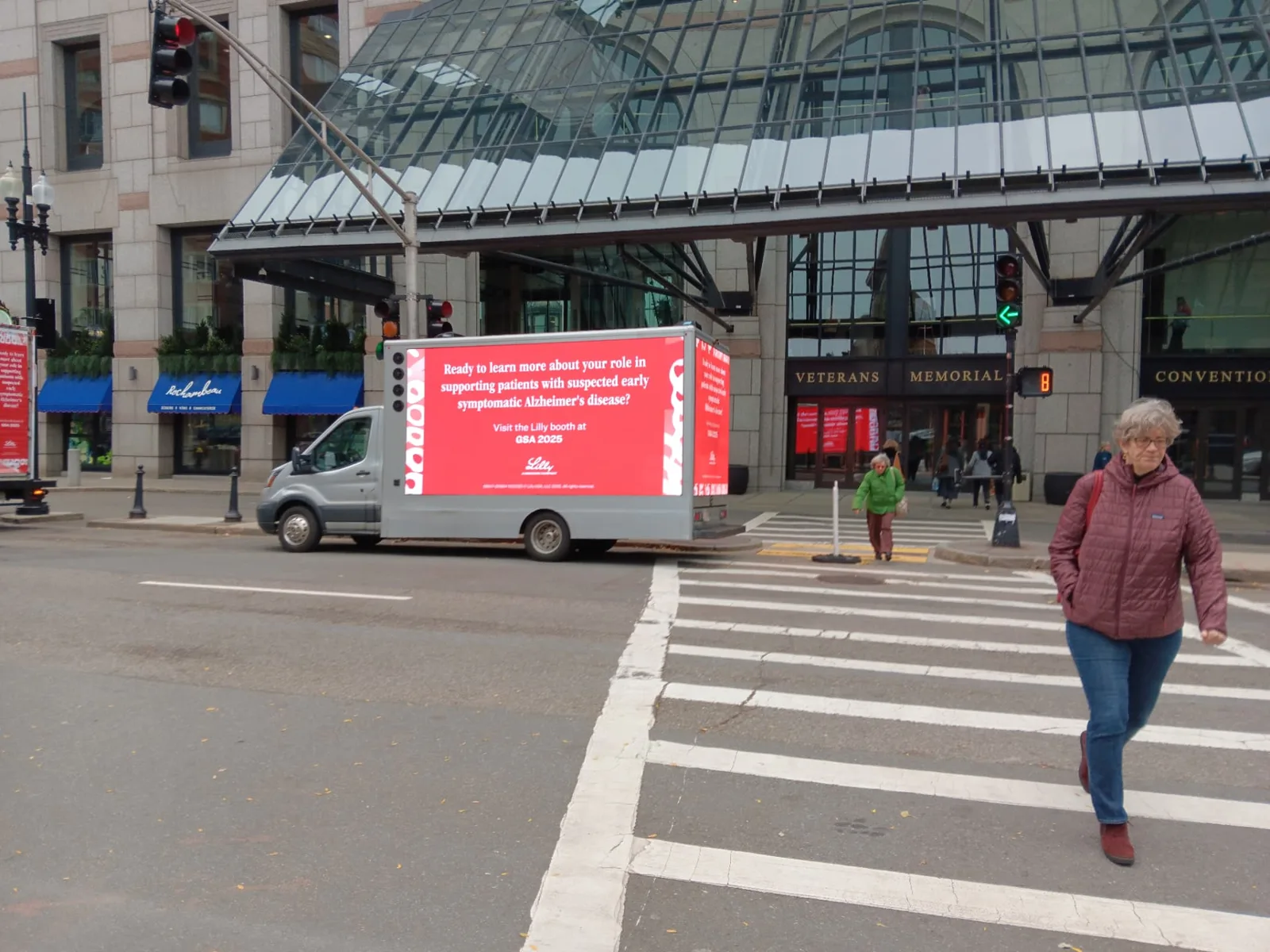
Client: Eli Lilly and Company. Event: GSA 2025, the Gerontological Society of America Annual Scientific Meeting, Boston. Objective: drive qualified clinician traffic to the Lilly booth. Channel: mobile LED billboard trucks circling the Hynes Convention Center and the surrounding Back Bay and downtown hotel blocks.
The short answer
Pharmaceutical convention marketing works best when your message reaches attendees outside the exhibit hall, where competitors cannot buy the space. For GSA 2025, Eli Lilly ran LED billboard trucks on a continuous loop around the Hynes Convention Center, the Prudential Center, Boylston Street, and the Seaport hotel corridor — putting a single, compliant call to action in front of thousands of geriatricians, researchers, and healthcare decision-makers every hour of the conference.
Why conventions are the highest-value moment in pharma advertising
Medical conferences concentrate an audience that is otherwise nearly impossible to reach at scale: specialists, KOLs, formulary decision-makers, investigators, and press, all inside a few square blocks for three to five days. Exhibit-hall booth space is expensive, crowded, and rationed by the organizer. The sidewalks, crosswalks, hotel driveways, and rideshare queues around the venue are not.
- Exclusivity. Convention centers sell interior signage to a handful of sponsors. Mobile LED trucks operate on public streets — no sponsorship tier required.
- Frequency. A single truck on a 20–30 minute loop passes the same attendee walking to sessions, to lunch, and back to the hotel.
- Proximity to action. The message lands minutes before the attendee walks into the hall, when a booth number is still actionable.
The Lilly creative: one question, one destination
The GSA 2025 creative was deliberately restrained: a single clinical question — "Ready to learn more about your role in supporting patients with suspected early symptomatic Alzheimer''s disease?" — followed by "Visit the Lilly booth at GSA 2025" and the Lilly wordmark, with required legal copy set at the base of the screen.
That structure is the pharma OOH playbook in miniature:
- Lead with the clinical audience, not the product. Disease-state and unbranded awareness messaging avoids the fair-balance obligations that make branded OOH nearly impossible on a moving screen.
- One destination. The booth. Not a URL, not a QR code, not a phone number — a physical location the reader is already walking toward.
- Legibility over decoration. High-contrast white on Lilly red, three lines of body copy, no imagery competing with the type.
- Legal copy present but subordinate. Required attribution and rights language sits at the bottom of the panel at readable size.
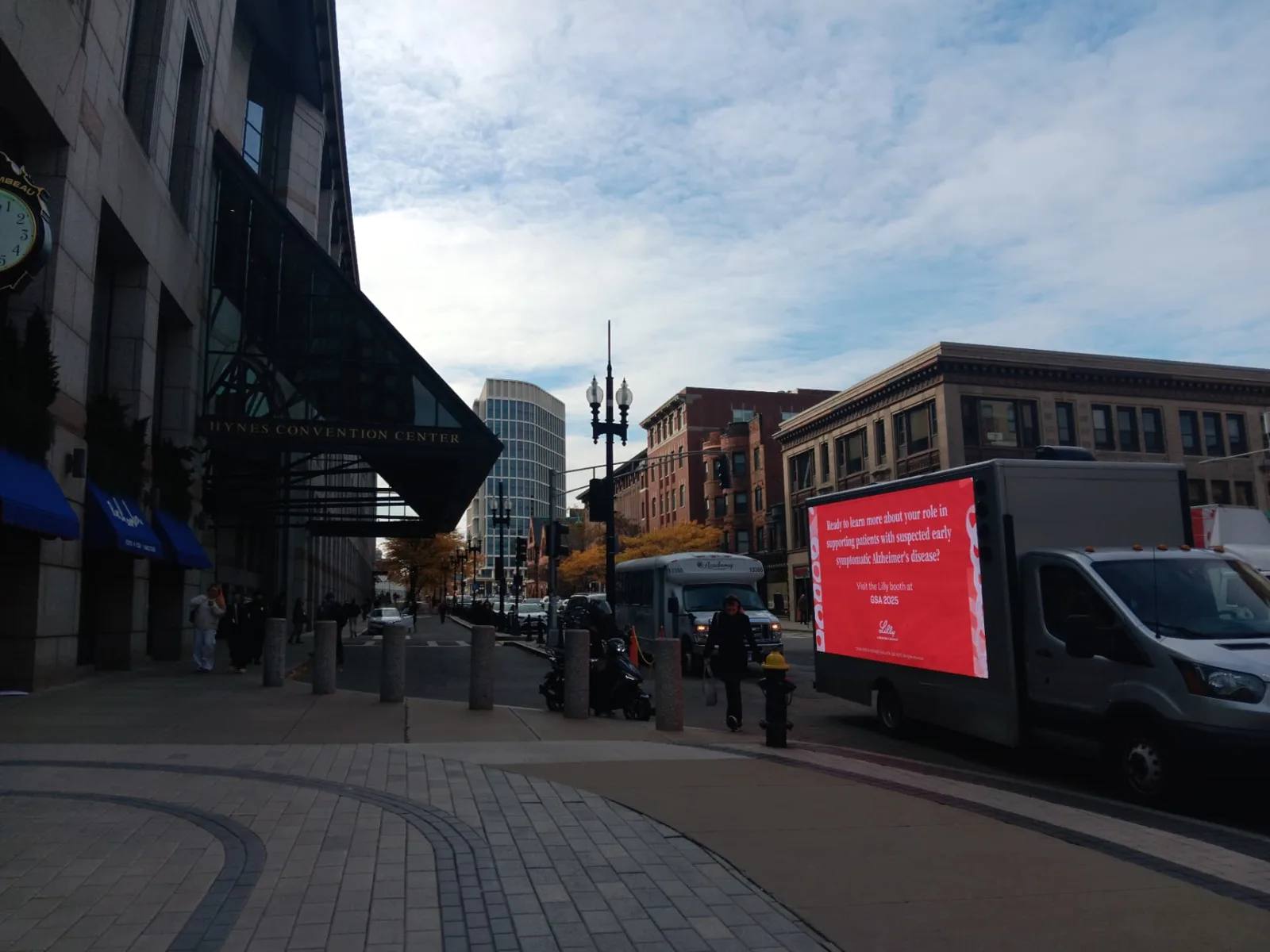
The route: where a Boston convention truck actually earns impressions
Boston''s convention geography is unusually friendly to mobile billboards because attendees walk. The Hynes sits inside a dense Back Bay grid with hotels, restaurants, and the Prudential Center within a few hundred feet. Our GSA 2025 route prioritized:
- Hynes Convention Center entrances on Boylston Street and inside the Prudential complex during the 7–10 a.m. arrival window.
- Sheraton Boston, Hilton Back Bay, Marriott Copley, and Westin Copley Place driveways — the official room blocks.
- Boylston, Huntington, and Dartmouth Street crosswalks between sessions.
- Seaport and Financial District loops for overflow hotels and evening dinner meetings.
- Copley Square and Newbury Street in the late afternoon, when attendees disperse.
Dayparting matters more at a convention than in any other campaign type. Impressions delivered at 3 a.m. are worthless; impressions delivered during the 45 minutes before a keynote are the entire point.
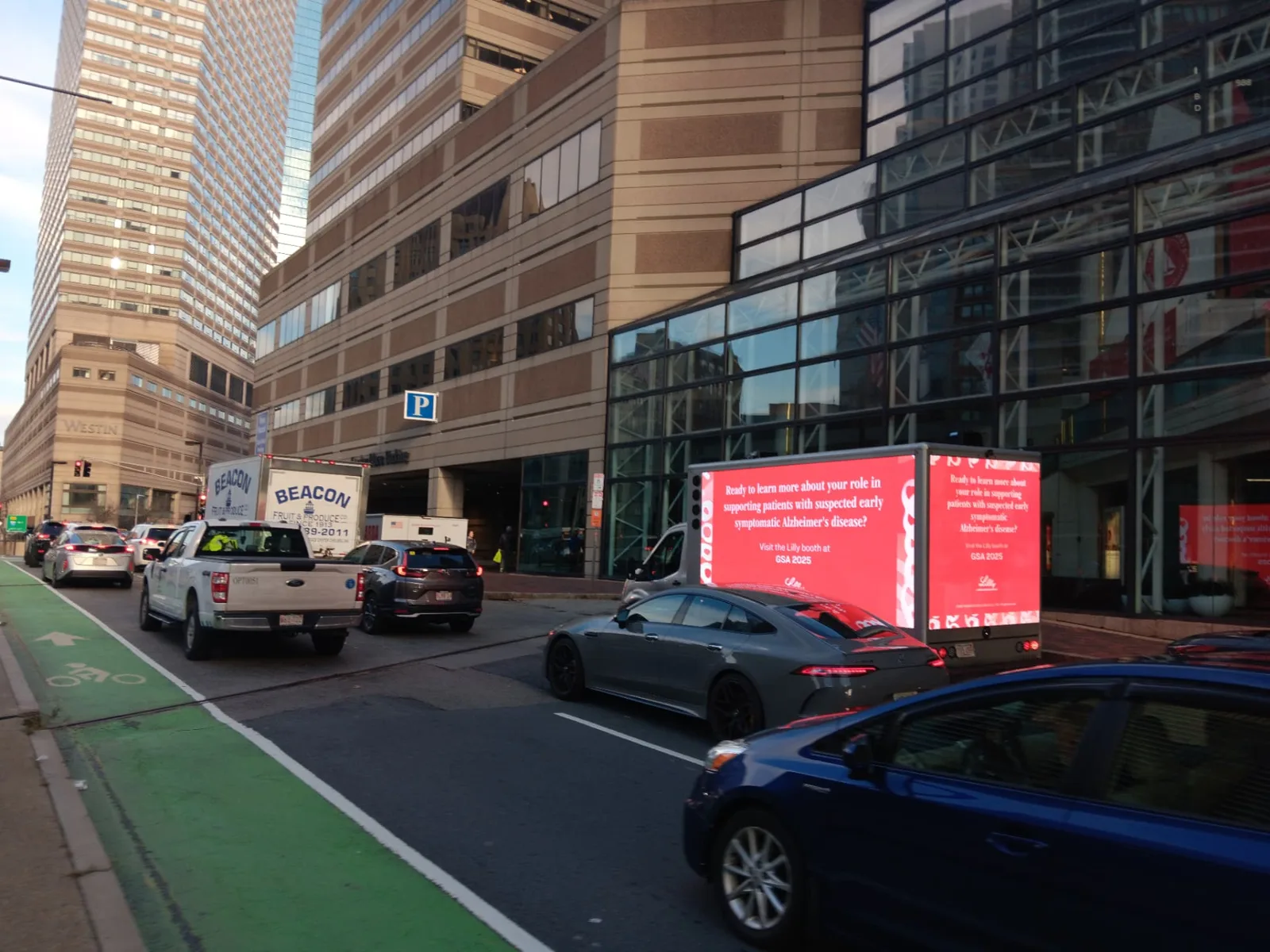
Compliance notes for pharmaceutical mobile billboard advertising
Pharma OOH carries obligations that consumer categories do not. Practical guidance we give every pharmaceutical and biotech client:
- Unbranded disease-state messaging is the safest path. Naming a product triggers fair-balance and risk-disclosure requirements that a moving vehicle cannot satisfy.
- Reminder ads (brand name with no efficacy claim) are an option, but require internal medical-legal-regulatory sign-off on the exact artboard, not a description of it.
- Route MLR the creative as a static asset. Submit the final pixel dimensions and the exact screen render, including legal type size.
- Keep the CTA venue-based. "Visit the booth" avoids the data-capture and adverse-event-reporting questions a QR code or form URL raises.
- Check the venue''s own rules. Some convention authorities restrict competitor advertising on their property; public streets are outside that jurisdiction, which is precisely the advantage.
What convention organizers can and cannot stop
Organizers control the exhibit hall, the badge, the app, the escalator wraps, and the hotel keycards. They do not control Boylston Street. A mobile LED billboard operating legally in traffic is not "guerrilla" or "ambush" in any actionable sense — it is a permitted vehicle displaying advertising on a public roadway. The practical constraint is not legal, it is operational: idling, loading zones, and bus lanes, all of which an experienced Boston operator routes around.
How to plan your own convention campaign
- Lock the dates and the hall. Book the truck 4–6 weeks out; Boston convention weeks sell out.
- Map the attendee day. Hotel block → venue → lunch → venue → dinner. That map is your route.
- Start MLR early. Creative approval is almost always the critical path, not production.
- Run all conference days, not just day one. Booth traffic peaks on day two for most medical meetings.
- Instrument what you can. Booth scans by day and hour, compared to the same meeting the prior year, is the cleanest available read.
Boston convention venues we cover
We run LED billboard trucks around the Hynes Convention Center, the Boston Convention & Exhibition Center (BCEC) in the Seaport, the Westin Boston Seaport District, Encore Boston Harbor, and the Cambridge biotech corridor around Kendall Square — plus every major convention city in the country.
Planning a pharma, biotech, or medical-device presence at an upcoming meeting? Request a quote and we''ll build the route around your booth number.
Frequently asked questions
Can pharmaceutical companies advertise on mobile billboard trucks?
Yes. Unbranded disease-state and awareness messaging is widely used and avoids the fair-balance requirements that make branded product advertising impractical on a moving screen. Reminder ads are possible with medical-legal-regulatory approval of the exact creative.
Is advertising outside a convention center allowed if you are not a sponsor?
Yes. Convention organizers control signage inside the venue and on its property, not the surrounding public streets. A legally operated LED billboard truck in traffic is not restricted by the sponsorship tier structure.
How much does a convention LED billboard truck campaign cost in Boston?
Most convention campaigns run roughly $800 to $1,500 per truck per day depending on hours, number of trucks, and creative production. Multi-day conference bookings typically price better per day.
Which Boston venues can you cover?
The Hynes Convention Center, the Boston Convention & Exhibition Center in the Seaport, Encore Boston Harbor, the Westin Boston Seaport District, and the Kendall Square biotech corridor in Cambridge.
How far in advance should we book a convention campaign?
Four to six weeks. Boston convention weeks sell out, and medical-legal-regulatory creative approval is usually the longest lead item in a pharma campaign.
How do you measure results at a conference?
Booth scan volume by day and hour compared with the same meeting the previous year is the cleanest read. Some clients add a dedicated landing page or a booth-staff intercept question.