
Orchestra AI: Three LED Billboard Trucks in San Francisco
A coordinated route plan connecting downtown visibility with an evening event.
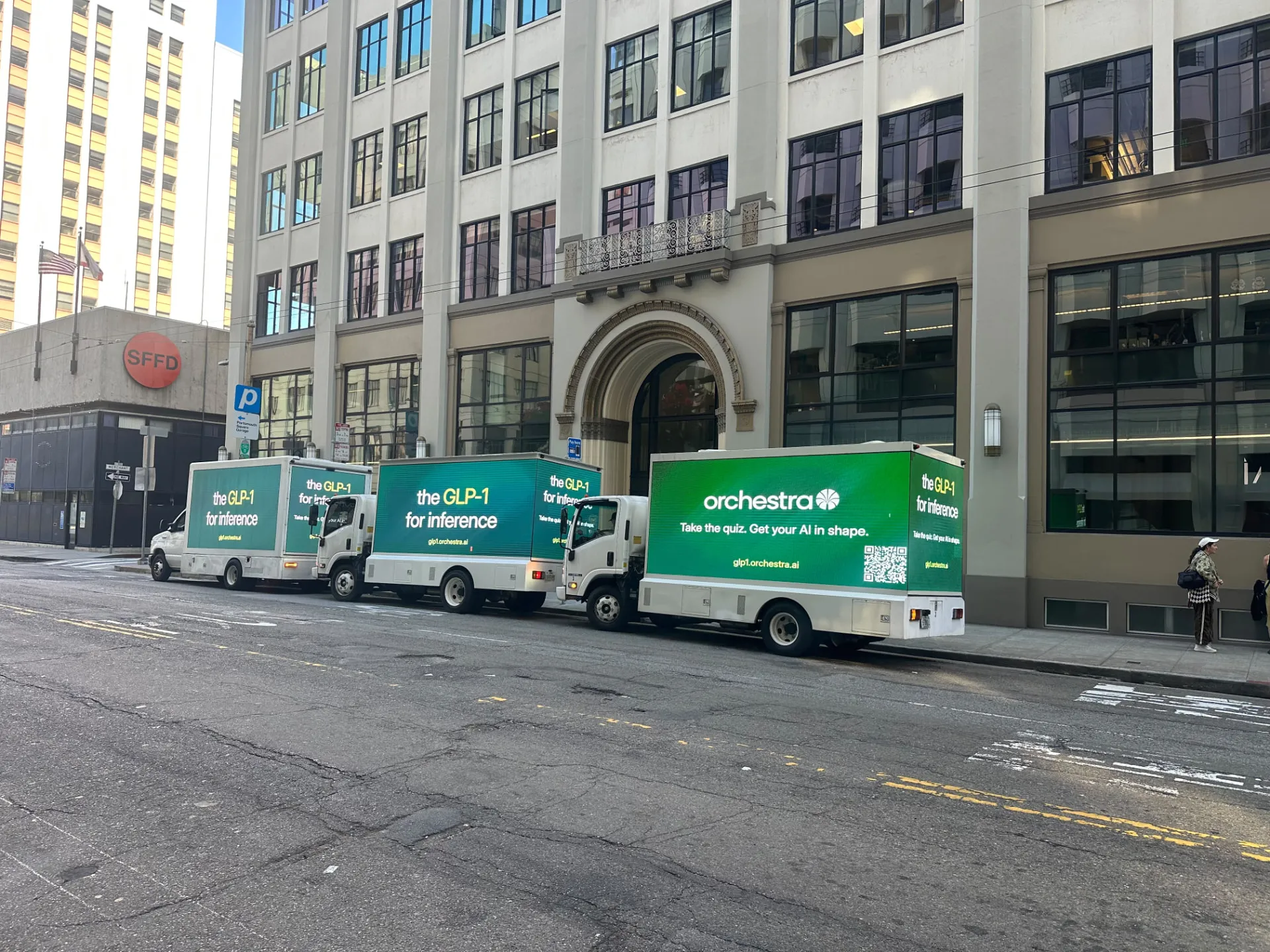
Orchestra AI’s three-truck LED billboard campaign in San Francisco.
For Orchestra AI’s San Francisco campaign, Boost Outdoor Media coordinated a three-LED-billboard-truck plan built around downtown photo opportunities, neighborhood coverage and an evening event. The supplied schedule ran from an 11:00 AM meeting near 564 Commercial Street to event-area coverage until 7:00 PM, with all times local to San Francisco.
The campaign photos show three trucks displaying Orchestra AI creative together on city streets. The route below is the campaign’s planned itinerary; the photos are not a stop-by-stop record of every scheduled location. The campaign date and measured results were not supplied.
Why three LED billboard trucks for an AI brand?
A three-truck campaign can combine a coordinated brand presence with separate neighborhood routes. For Orchestra AI, the plan used both: bring the vehicles together for photos and lunch-hour visibility, then spread them out before an evening reunion.
That format suits a B2B brand seeking street-level exposure around offices and an event without tying every hour to one fixed advertising location. It also gives the campaign team distinct content moments: the full fleet together, individual street views and matching screens along a block. Those are planning benefits, not a claim of verified impressions or sales.
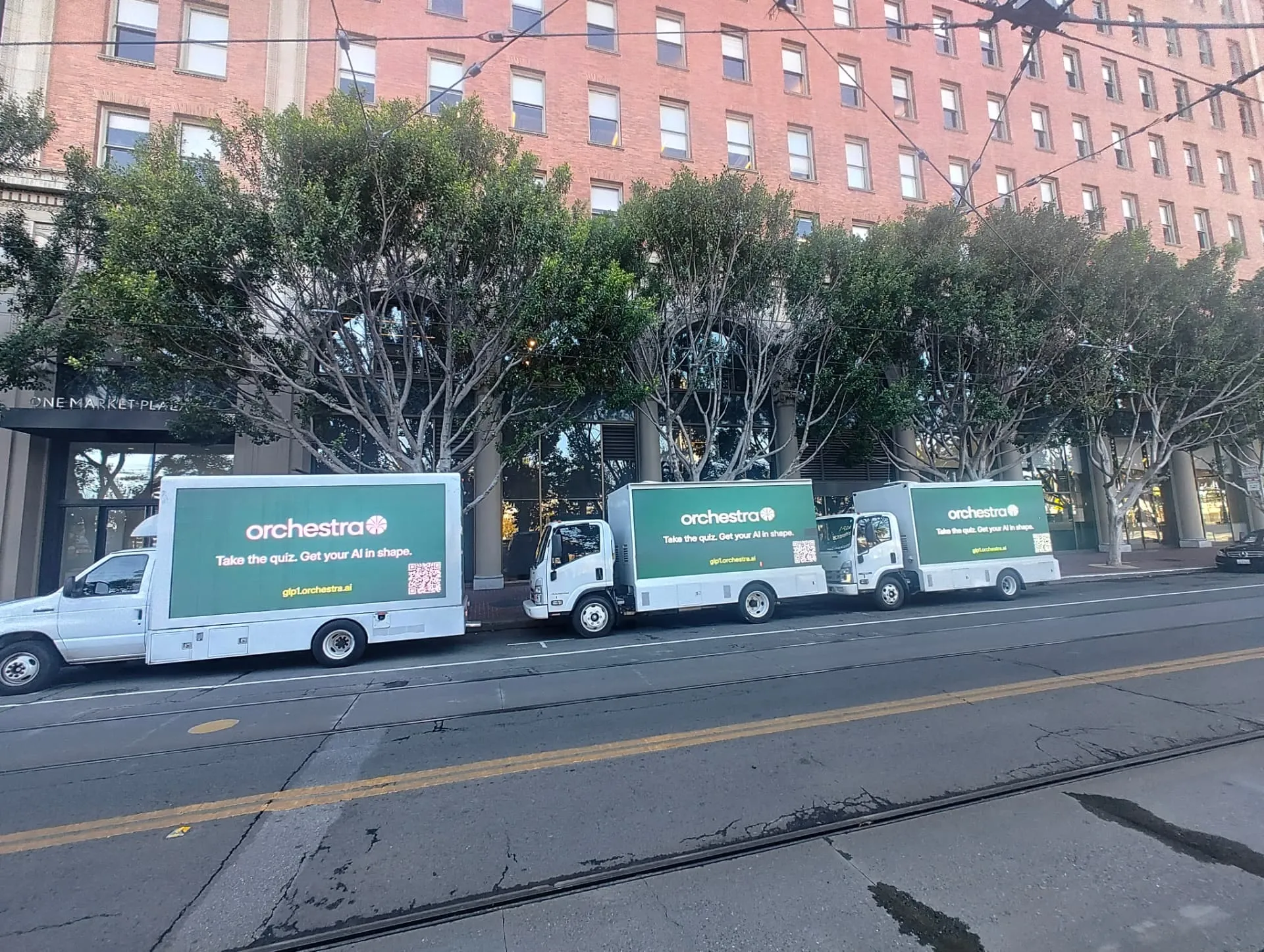
The San Francisco three-truck route plan
The itinerary alternated between fleet-wide photo sessions, distributed downtown coverage and a coordinated arrival near the evening event. It targeted the Financial District, Yerba Buena, Mission Bay and surrounding areas rather than treating the entire city as one undifferentiated route.
| Local time | Planned activity | Campaign purpose |
|---|---|---|
| 11:00 AM | All three trucks meet near the office at 564 Commercial Street. | Initial photo session with the fleet together. |
| 12:00–1:00 PM | Keep the trucks together in the Financial District. | Additional photos during the lunch rush. |
| 1:00–5:00 PM | Spread the trucks across the Financial District, Yerba Buena, Mission Bay and surrounding areas. | Distributed neighborhood coverage. |
| 5:30 PM | Bring all three trucks together near 41 Decatur Street. | Coordinated presence near the event. |
| Until 7:00 PM | Continue coverage around the event area as appropriate. | Support the evening event window. |
The schedule left the transition between the afternoon routes and the 5:30 PM meeting available for repositioning. Actual stopping locations and routes must account for traffic, legal curb access, loading zones and conditions on the day; a planned address does not guarantee a parking space or permission to occupy it.
Financial District, Yerba Buena and Mission Bay coverage
The afternoon plan assigned coverage across three named San Francisco areas instead of keeping all vehicles together all day. The aim was to balance a strong fleet photo with a broader street-level presence.
The Financial District formed the office and lunch-hour portion of the plan. Yerba Buena and Mission Bay extended the afternoon route into other downtown and nearby neighborhoods. For another campaign, those locations should be selected around the actual audience, office addresses and event venue—not copied automatically from this itinerary.
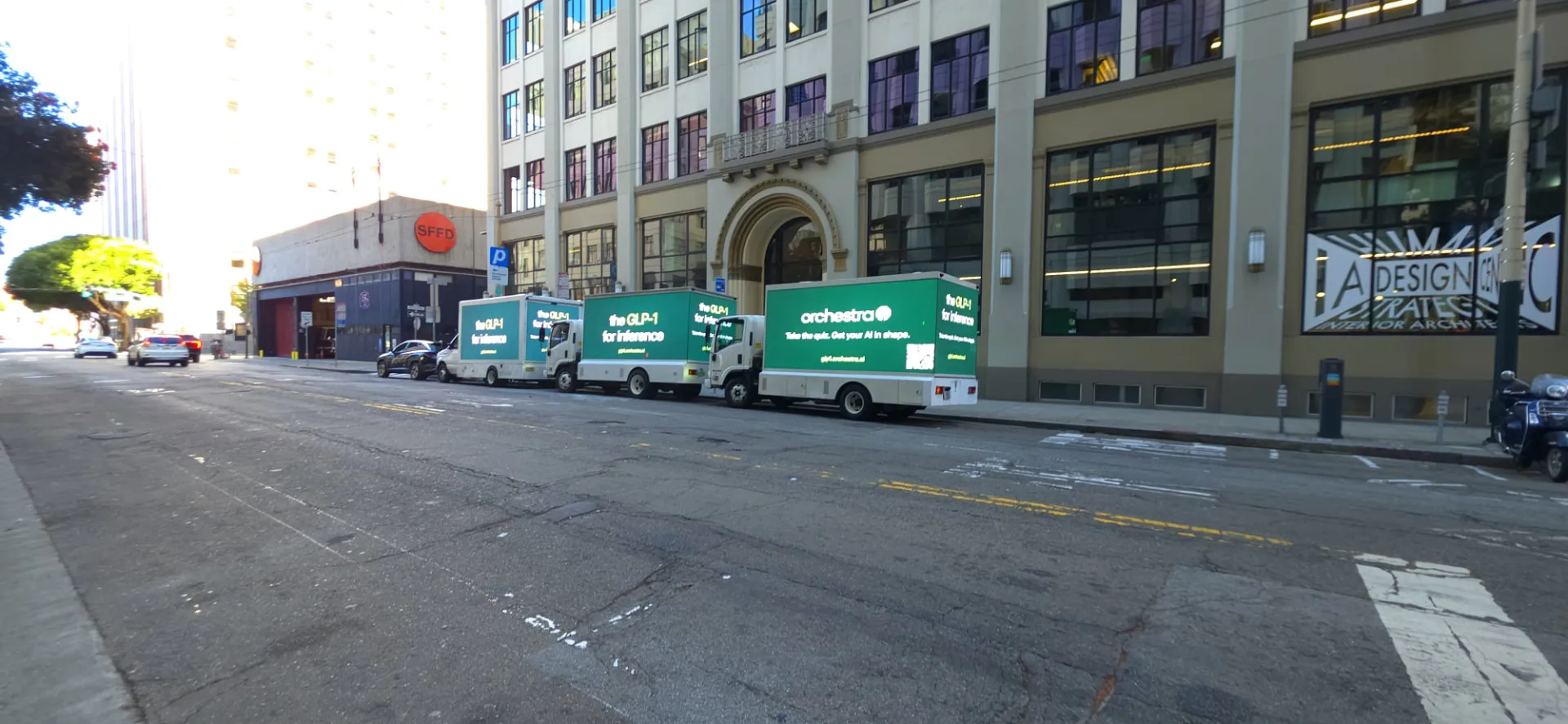
Creative built for a coordinated fleet
Orchestra AI used matching green screens with its brand name, a QR code and the line “Take the quiz. Get your AI in shape.” Other screens carried the phrase “the GLP-1 for inference,” giving the fleet related messages rather than unrelated advertisements.
That phrase is Orchestra AI’s advertising metaphor for AI inference; it does not make this a pharmaceutical campaign, and we are not presenting it as a verified product-performance claim. The photos show how a short headline and consistent design can connect several vehicles visually while leaving room for different messages.
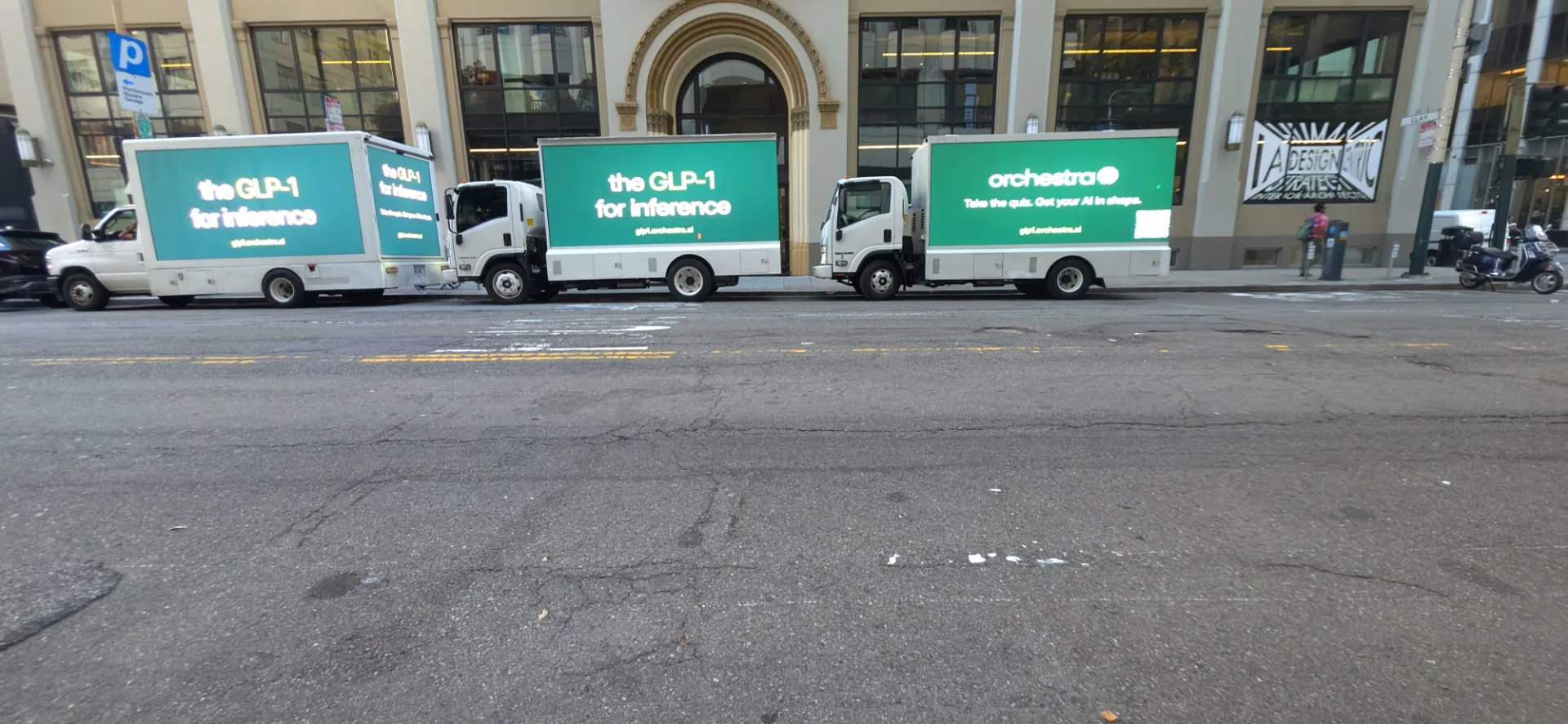
Watch the Orchestra AI campaign video
The supplied video offers a brief street-level view of the Orchestra AI trucks and their matching screens. It complements the still photos rather than serving as evidence that every planned stop was completed.
Original campaign footage of Orchestra AI LED billboard trucks on a San Francisco street.
Planning LED truck advertising around a B2B event
An event-led mobile billboard plan should connect the daytime audience with the evening venue and give each truck a clear assignment. This San Francisco itinerary provides a useful example: assemble, distribute, then reunite.
- Set the shared photo windows first. A fleet photo requires all drivers to reach the same area, so it needs an explicit meeting time.
- Assign separate coverage areas. Give each vehicle a clear neighborhood or route rather than letting three trucks duplicate the same afternoon loop.
- Allow time to regroup. Repositioning for an evening event must account for traffic and curb conditions.
- Keep the message readable. Use a concise headline, recognizable brand and a clear next step; check that the destination behind a QR code works on a phone.
- Plan measurement separately. Tagged links, campaign-specific QR codes and agreed reporting can support evaluation. No scan counts, impressions or lead totals were provided for this campaign.
Explore LED billboard truck advertising across California
For a campaign like Orchestra AI’s three-truck activation, start with our San Francisco LED billboard truck advertising page. For a broader regional plan, explore California mobile billboard advertising and choose city coverage around your audience and event venue.
Compare nearby Bay Area options in Oakland and San Jose, or explore LED billboard truck advertising in Sacramento, Los Angeles and San Diego. These links are planning resources for future campaigns, not a claim that Orchestra AI ran this activation in those cities.
Applying the approach beyond San Francisco
The assemble–distribute–reunite format can be considered for AI launches, corporate events and B2B campaigns in other markets. The local route still needs to be built around the actual offices, venue, audience and operating conditions.
A team planning a campaign in New York, Boston, Chicago, Los Angeles or another city can use this structure as a starting point, not as evidence of an Orchestra AI campaign in those cities. A multi-truck quote should also specify vehicle availability, operating hours, route coordination and any event-specific requirements.
Planning a product launch or corporate event? Explore our Corporate & B2B advertising options and mobile LED billboard service, review the mobile billboard advertising cost guide, or request a route plan and quote from Boost Outdoor Media.
Frequently asked questions
Can I book three LED billboard trucks for a San Francisco event?
A coordinated multi-truck campaign can be planned around an office, several neighborhood routes and an event venue. Boost Outdoor Media’s Orchestra AI case study shows a three-truck format. Availability, legal stopping locations, operating hours and pricing need to be confirmed for your specific date.
Where were the Orchestra AI trucks scheduled to go in San Francisco?
The plan began near 564 Commercial Street at 11 AM, kept the trucks together in the Financial District from noon to 1 PM, and distributed coverage across the Financial District, Yerba Buena, Mission Bay and surrounding areas from 1 to 5 PM. All three were scheduled to meet near 41 Decatur Street at 5:30 PM, with appropriate event-area coverage until 7 PM. These are planned stops, not independently verified completed visits.
Why keep billboard trucks together and then split them up?
Keeping the fleet together supports coordinated photos and a consistent brand presence in one area. Splitting the vehicles later allows separate routes to cover different neighborhoods. The Orchestra AI plan combined those approaches before bringing the fleet back together near an evening event.
Was Orchestra AI’s GLP-1 for inference campaign a pharmaceutical advertisement?
No. The photographed trucks advertise Orchestra AI and use the phrase GLP-1 for inference as the advertiser’s AI-related metaphor. Boost Outdoor Media does not present that wording as a medical claim or a verified product-performance claim.
How much does a three-truck San Francisco campaign cost?
No price was supplied for the Orchestra AI campaign. A quote for a similar activation should specify the number of trucks, operating hours, date, routes and event coordination requirements. Ask Boost Outdoor Media for a campaign-specific quote rather than assuming a one-truck price covers the entire fleet.
Did this campaign generate verified impressions or leads?
No impression counts, QR scan totals, attendance figures or lead results were supplied for this case study. The photos and video document the trucks and creative, while the itinerary explains the planned coverage. Future campaigns can agree on measurement methods before launch.