
Nonprofit Advocacy in Boston: End of Life Options Massachusetts LED Billboard Campaign
How a mobile LED billboard brought patient stories and a legislative message directly to Beacon Hill
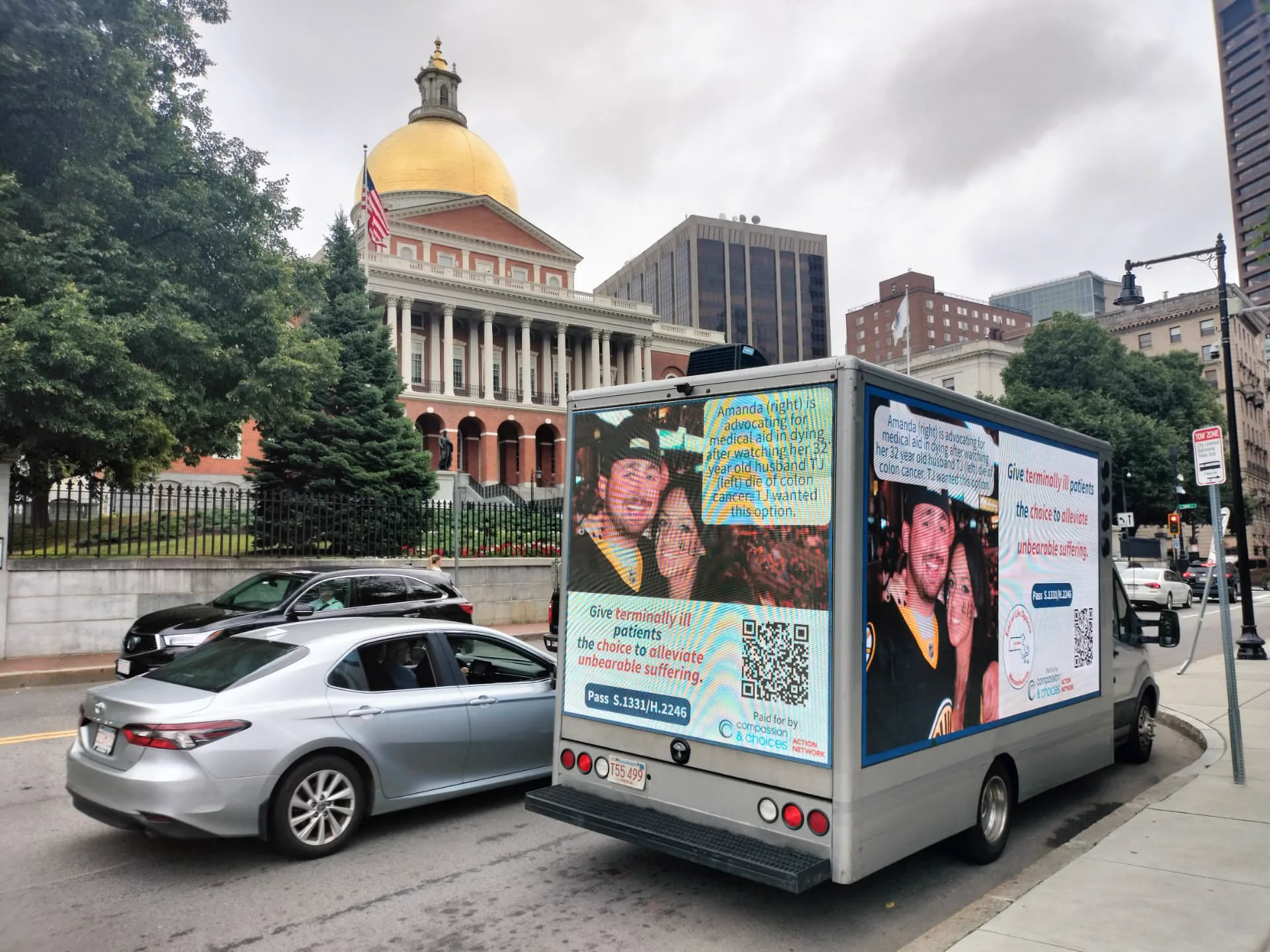
The End of Life Options Massachusetts mobile LED billboard campaign positioned patient stories and S.1331/H.2246 messaging beside the Massachusetts State House in Boston.
End of Life Options Massachusetts used a mobile LED billboard truck in Boston to carry patient stories and its support for S.1331/H.2246 directly to Beacon Hill. The campaign demonstrates how a nonprofit can combine precise location targeting, personal storytelling, and a simple action step in one highly visible advocacy activation.
A nonprofit message positioned at the Massachusetts State House
The campaign placed its message where state policy is debated. On July 25, 2024, the LED billboard truck circulated beside the Massachusetts State House and through Beacon Hill. The gold dome in the campaign photography made the intended audience unmistakable: legislators, government staff, advocates, residents, commuters, and visitors moving through the center of state government.
For nonprofit advocacy, location is part of the message. A campaign about Massachusetts legislation gains context when it appears outside the State House rather than on an untargeted highway loop. The truck created a visible connection among the people featured in the creative, the bills named on screen, and the public officials considering them.
The campaign put patient stories at street level
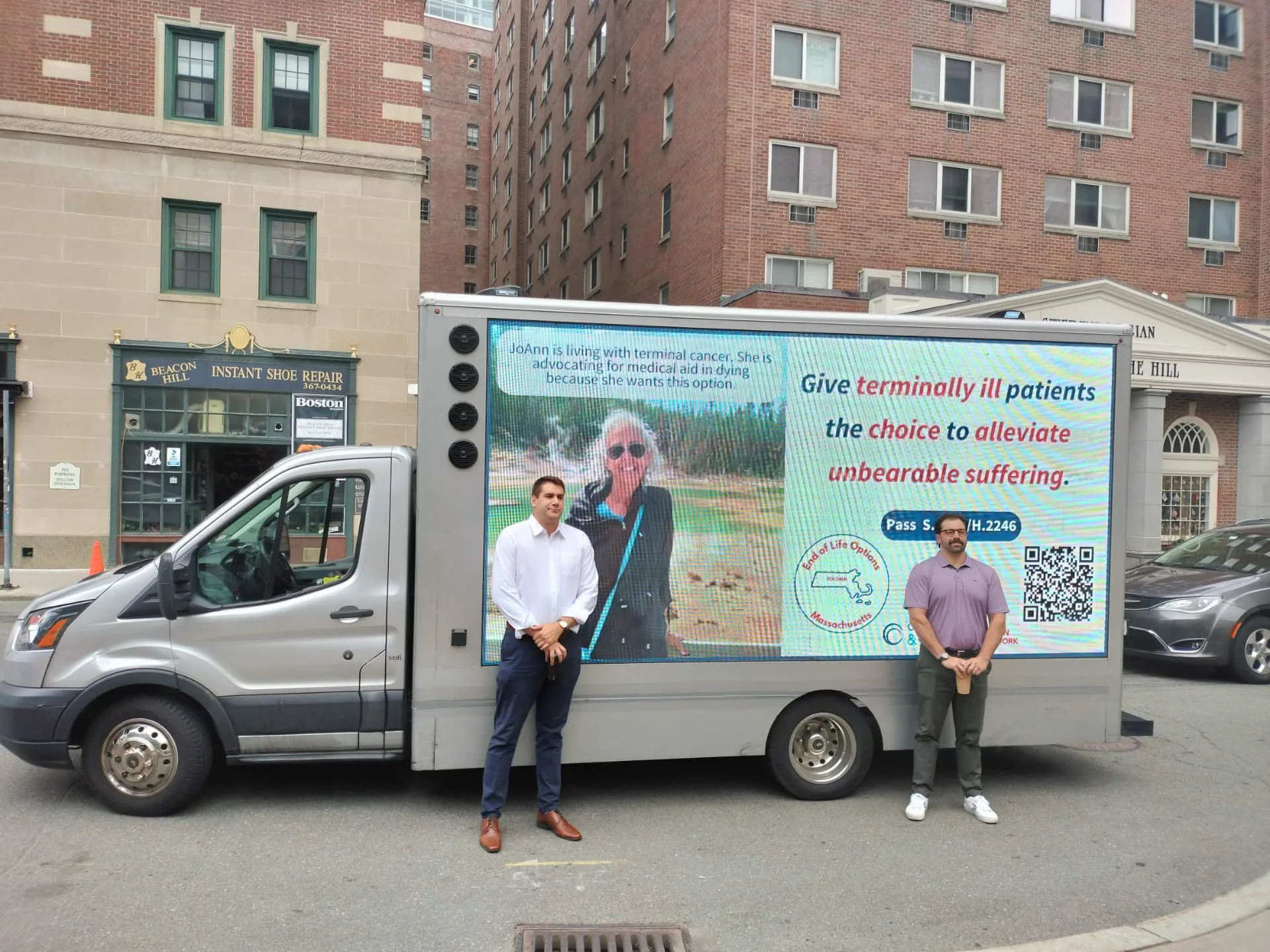
The LED creative featured Massachusetts residents Amanda and JoAnn. Their portraits appeared beside brief first-person statements and the organization’s call to “Give terminally ill patients the choice to alleviate unbearable suffering.” The screens also identified S.1331/H.2246 and included a QR code that gave viewers a next step.
Those statements are the advocacy messages of End of Life Options Massachusetts. Presenting them on a large street-level screen helped make a complex and deeply personal policy issue understandable at a glance without asking a passerby to read a long explanation.
Why mobile LED billboards work for nonprofit advocacy
A mobile LED billboard gives a nonprofit control over geography, timing, message rotation, and visual documentation. That combination is especially useful when a campaign needs to reach a narrow group such as lawmakers, convention attendees, donors, community leaders, or residents of a specific district.
- Precise location targeting: the route can concentrate around a state house, city hall, hearing venue, conference, fundraiser, or community event.
- Multiple messages: digital screens can rotate different personal stories, calls to action, bill numbers, and QR codes during the same campaign.
- High visual impact: a large moving display can break through the visual clutter surrounding busy civic and downtown locations.
- Reusable campaign content: photographs of the activation can support email, social media, donor updates, press outreach, and future advocacy.
- Flexible routing: the truck can remain near one priority building or connect several relevant locations in a planned sequence.
The legislative context behind the Boston campaign
S.1331 and H.2246 were both titled “An Act relative to end of life options” in the Massachusetts 193rd General Court. End of Life Options Massachusetts describes itself as a coalition of organizations that educates state legislators and the public about end-of-life options, including medical aid in dying. The coalition advocated for legislation that it said would offer an additional option to eligible, terminally ill adults.
At the time of the July 2024 campaign, S.1331 had advanced to the Senate Committee on Ways and Means. The bill did not ultimately advance before the 2024 session ended. This article documents the advertising strategy and the coalition’s stated position; Boost Outdoor Media does not independently assert the medical or policy claims shown in the campaign creative.
How the Boston route supported the nonprofit’s goal
The strongest advocacy routes prioritize relevance over raw mileage. In this campaign, Beacon Hill and the Massachusetts State House gave the creative a direct relationship to the legislation named on the truck. Nearby streets also carry a mix of pedestrian, commuter, government, and visitor traffic.
The campaign photography shows the truck both beside the State House and on a nearby Boston street. That created two useful views: a clear establishing image connecting the campaign to Beacon Hill, and a close street-level view showing the scale and readability of the LED creative.
Organizations planning similar work can learn from that approach. Start with the single decision-making location that matters most, then build a compact route around nearby arrival points, lunch corridors, public entrances, and departure paths. Repeated visibility among the right audience is often more useful than covering a large area once.
Five lessons for nonprofit awareness campaigns
This Boston activation offers a practical playbook for nonprofits planning public-awareness or legislative campaigns.
- Put the message where the decision is happening. A relevant civic backdrop immediately communicates why the campaign is there.
- Let real people carry the story. Portraits and first-person statements can make an abstract issue human and memorable.
- Keep the policy action short. Bill numbers, a concise position, and one call to action are easier to understand from the street.
- Add a path to learn more. A large QR code lets interested viewers move from awareness to detailed information.
- Plan the documentation. Strong photographs can extend the value of a one-day activation through press, social, email, and stakeholder reporting.
Nonprofit LED billboard campaigns in Boston and nationwide
The same strategy can support nonprofit campaigns beyond Beacon Hill. Mobile LED billboard trucks can target state capitols, municipal buildings, legislative offices, conferences, fundraising events, community gatherings, hospital districts, university campuses, and other locations tied to an organization’s audience.
Boost Outdoor Media plans advocacy and political advertising campaigns, Boston mobile billboard routes, and mobile LED billboard truck campaigns nationwide. We can help define the priority audience, select a route, sequence creative, and document the activation.
Plan a nonprofit mobile billboard campaign
A strong nonprofit campaign starts with one audience, one clear action, and a route built around where that audience will be. If your organization needs to build awareness, support an advocacy initiative, reach policymakers, or bring community stories into public view, contact Boost Outdoor Media to discuss campaign timing, locations, creative rotation, and truck availability.
Frequently asked questions
How can a nonprofit use a mobile LED billboard truck?
A nonprofit can use a mobile LED billboard truck to place an awareness or advocacy message near the people and locations most connected to its goal. Common targets include state houses, city halls, legislative offices, conferences, fundraising events, campuses, and community gatherings.
What was the End of Life Options Massachusetts billboard campaign about?
The July 2024 Boston campaign shared patient stories and the coalition’s support for Massachusetts bills S.1331 and H.2246. The LED creative named the bills, displayed a concise advocacy message, and included a QR code for viewers who wanted more information.
Why was the Massachusetts State House an effective location?
The State House connected the campaign directly to the lawmakers, staff, advocates, and public audiences involved in Massachusetts policy. Beacon Hill also provided a recognizable setting that made the purpose of the campaign clear in photographs and follow-up communications.
Can a nonprofit show several stories during one billboard campaign?
Yes. A digital mobile billboard can rotate multiple portraits, testimonials, calls to action, and QR codes during one route. The creative should remain concise enough to understand quickly from the street.
Do nonprofit mobile billboard campaigns only work in Boston?
No. Boost Outdoor Media plans mobile LED billboard campaigns nationwide. Routes can target state capitols, government offices, conventions, community events, hospital districts, universities, and other places relevant to a nonprofit’s audience.
How should a nonprofit plan an advocacy billboard route?
Start with the primary audience and the single location most connected to the decision or event. Then plan repeated passes around entrances, arrival and departure corridors, and nearby high-traffic streets while allowing time to photograph the activation.