
Mobile Billboard Advertising: What It Is and How It Works
A complete guide to LED billboard trucks, routes, costs, and results
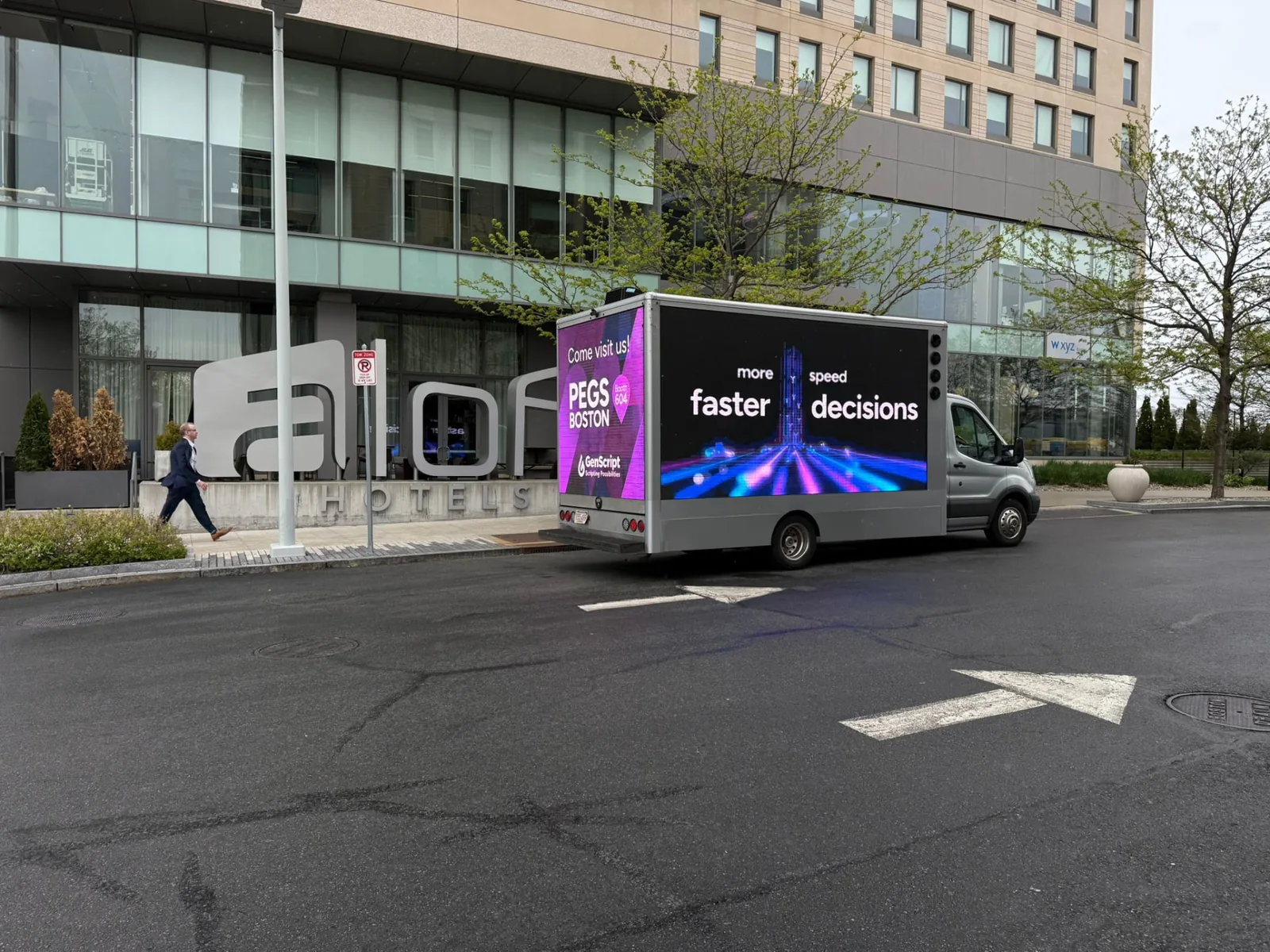
A mobile billboard truck staged outside attendee hotels during a Boston conference.
Mobile billboard advertising puts a large-format ad on a truck and drives it through the places your customers actually are — downtown streets, stadium and arena crowds, retail corridors, conference districts, and commuter routes. Instead of waiting for people to pass a fixed billboard, the billboard goes to them. This guide explains what it is, how it works, what it costs, and when it beats other out-of-home options.
What is mobile billboard advertising?
A mobile billboard is an advertising display mounted on a vehicle — most often a box truck with screens or printed panels on both sides and the rear. A driver runs a planned route through targeted areas for a set number of hours per day. Modern trucks use LED screens, which display full-motion creative and can be updated remotely.
How does it work, step by step?
- Define the audience and geography. A neighborhood, a venue, a list of competitor locations, a commuter corridor, or an entire metro.
- Build the route. Loops are designed around dwell time — traffic lights, crosswalks, event entrances and parking exits are where impressions are worth the most.
- Supply creative. One image or a short video. Big type, one idea, a clear call to action.
- Run the flight. Typically 6–8 hours per day, one or more days, with dayparting to match when your audience is out.
- Get proof. GPS route logs and geo-tagged photos confirm exactly where and when the ad ran.
What does mobile billboard advertising cost?
Pricing is usually quoted as a day rate or a multi-day package, not a CPM. The main drivers are market, number of hours per day, number of days, whether the truck is dedicated or shared, and whether the run targets a high-demand event. Multi-day and multi-week flights lower the daily rate meaningfully, and there is no print production bill on an LED truck. For an exact number in your city, request a quote — rates vary by market.
Who uses it?
- Retail and restaurants — grand openings, limited-time offers, store addresses.
- Events, festivals, and trade shows — ticket pushes, booth numbers, day-of wayfinding.
- Political campaigns and advocacy groups — district-level targeting and rapid response.
- Healthcare systems — service lines, ER wait times, new location announcements.
- Recruiting and staffing — hiring events, pay and sign-on bonuses, targeted at competitor sites and logistics corridors.
- Real estate and developers — new construction, leasing, open houses.
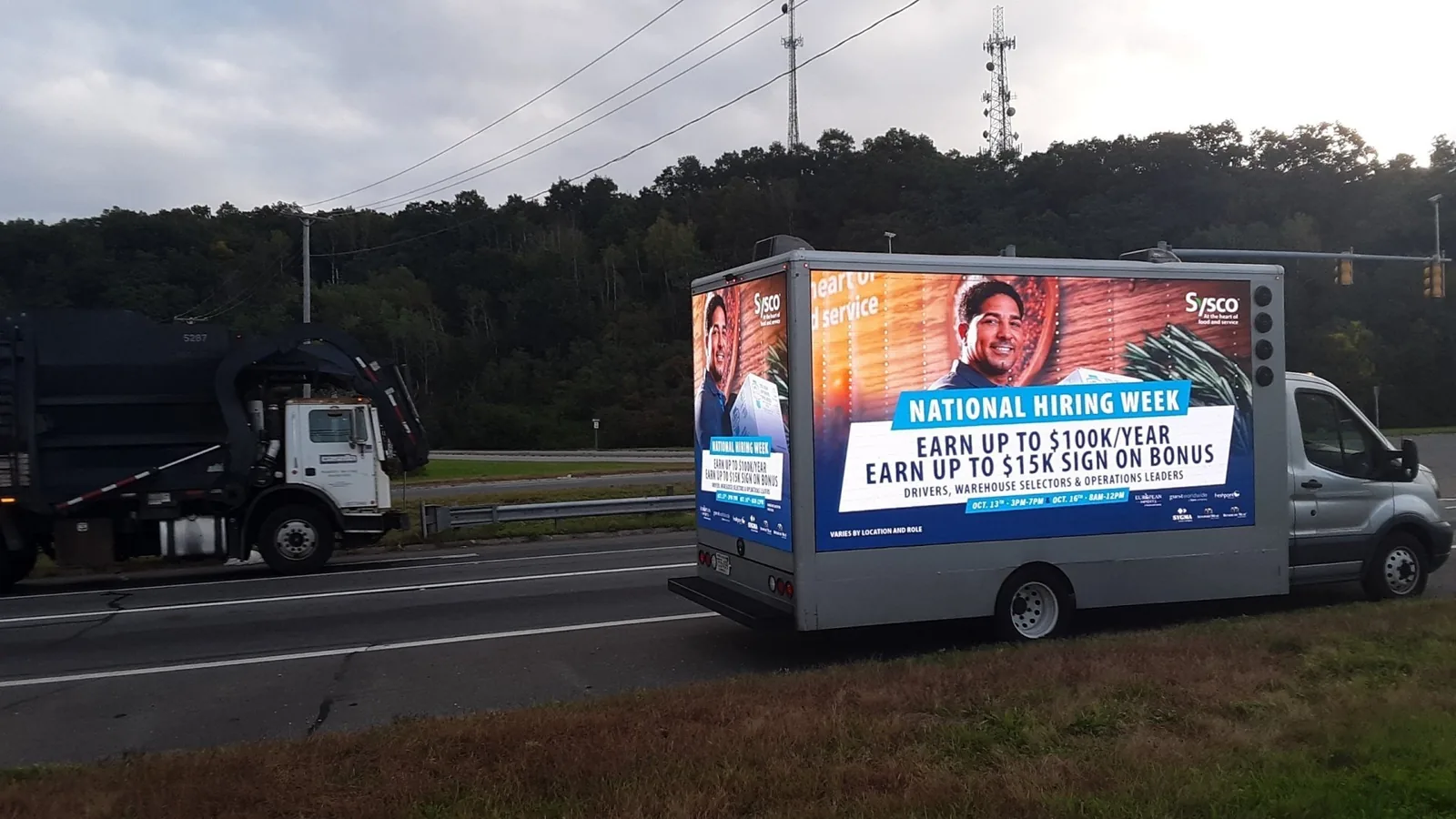
Mobile billboards vs other out-of-home
| Mobile billboard | Static roadside billboard | Transit / bus | |
|---|---|---|---|
| Targeting | Street-level, route-controlled | Fixed location only | Fixed transit routes |
| Minimum buy | One day | Usually four weeks | Usually four weeks |
| Creative changes | Same day on LED | Reprint and reinstall | Reprint and reinstall |
| Event targeting | Excellent | Only if a board is nearby | Limited |
| Proof of run | GPS logs and photos | Photo sheet | Photo sheet |
Is it effective?
Out-of-home research consistently shows mobile billboards generate high recall because the display is at eye level, moves through the viewer's environment, and is difficult to skip or block. See our mobile billboard advertising statistics page for the research summary. The practical advantage is control: you choose the streets, the hours, and the message, and you can change any of them mid-flight.
Creative rules that actually matter
- Seven words or fewer on the primary line.
- Huge type and high contrast — assume a three-second read from 40 feet.
- One call to action: a short URL, a phone number, or a location. Not all three.
- Keep the logo present but small; the offer is the hero.
- Design for both the side screen and the narrower rear screen.
Getting started
Pick a market, pick a date, and send artwork. If you want to see how the format plays in your city, browse markets we serve, review the mobile LED billboard service, or look at LED trucks for sale if you are considering running your own fleet.
Frequently asked questions
What is mobile billboard advertising?
Mobile billboard advertising is out-of-home advertising displayed on a truck that drives a planned route through targeted areas, rather than sitting in one fixed roadside location.
How much does mobile billboard advertising cost?
It is priced as a day rate or a multi-day package rather than a CPM. Cost depends on the market, hours per day, number of days, and whether the truck is dedicated or shared. Multi-day flights lower the daily rate.
How long does a mobile billboard campaign run each day?
A typical flight runs six to eight hours per day, scheduled around when the target audience is out — commute, lunch, evening, or event windows.
Does mobile billboard advertising work?
Out-of-home research shows high recall for mobile billboards because the display is at eye level, moves through the viewer's environment, and cannot be skipped or ad-blocked. Route control and same-day creative changes make it easy to optimize mid-flight.
What proof do I get that the truck ran my route?
GPS route logs plus geo-tagged, time-stamped photos from the run confirm exactly where and when your ad was displayed.
How is it different from a static roadside billboard?
A roadside billboard is one fixed location usually sold in four-week cycles. A mobile billboard can be booked for a single day, targets specific streets and events, and on LED can change creative the same day.