
LED Billboard Truck Advertising vs Static Billboard Trucks
Which mobile billboard format actually delivers more for your budget
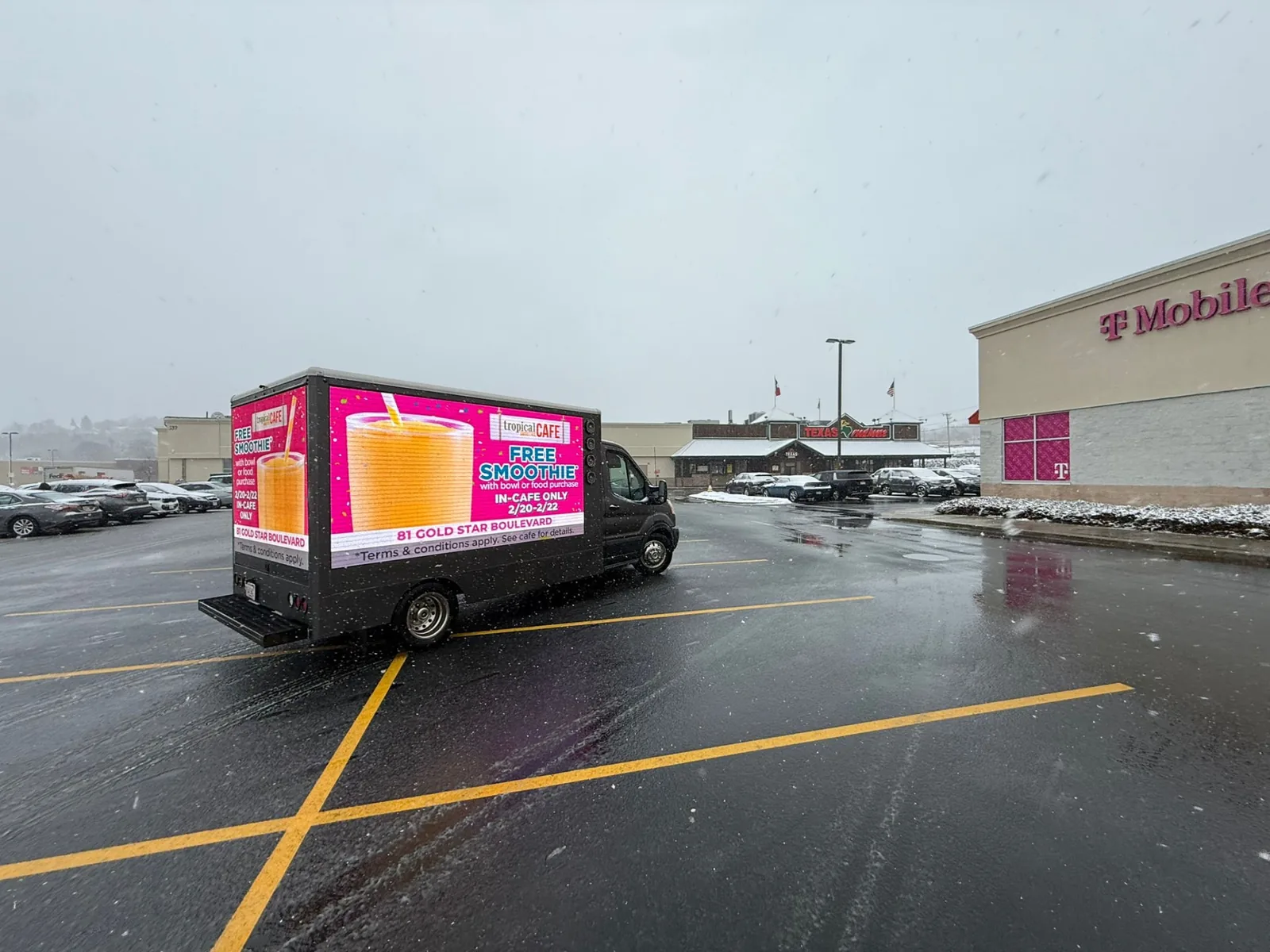
An LED billboard truck running a dated retail offer — the kind of creative a static vinyl truck cannot keep up with.
If you are comparing LED billboard truck advertising to a traditional static billboard truck, the short version is this: both put a large ad on the street, but only one of them can change the message, run motion, and prove when and where it ran. Here is an honest side-by-side so you can pick the right format for your budget and your campaign.
What is the difference between an LED truck and a static billboard truck?
A static billboard truck (sometimes called a vinyl or poster truck) carries printed vinyl panels bolted to a frame. The artwork is produced at a print shop, shipped, and installed. Once it is on the truck, that is the ad for the length of the campaign.
An LED billboard truck carries digital screens — typically a large side screen plus a rear screen — driven by a media player. Creative is uploaded as a file or a short video. You can change it in minutes, rotate multiple advertisers or offers, run animation, and display the ad brightly after dark.
Side-by-side comparison
| Factor | LED billboard truck | Static billboard truck |
|---|---|---|
| Creative changes | Minutes, remotely or on site, at no print cost | New vinyl print plus install, usually days |
| Motion & video | Yes — animation, video, live data feeds | No |
| Night visibility | Self-illuminated, strong after dark | Needs external lighting; weak at night |
| Multiple messages per day | Yes — dayparting and rotation | One message for the whole flight |
| Multiple advertisers on one truck | Yes, shared rotation lowers cost per advertiser | No |
| Weather and wear | Screen is sealed; no fading or peeling | Vinyl fades, wrinkles, and can tear |
| Up-front production | Digital file — no print bill | Print and install cost per creative |
| Day rate | Higher | Lower |
| Proof of performance | GPS route logs plus geo-tagged photos | Photos, sometimes GPS |
When a static billboard truck still makes sense
- One message, long flight, daytime only — for example a months-long brand awareness run with no offer changes.
- Tight budget where the lower day rate matters more than flexibility.
- Large-format sizes where a single printed panel is genuinely bigger than the available screen.
When LED wins
- Retail and promotions. Dated offers, flash sales, and store-specific addresses change constantly. Reprinting vinyl for each one is not realistic.
- Events, conferences, and trade shows. Booth numbers, session times, and calls to action shift by the hour.
- Political and advocacy. Message discipline changes with the news cycle; you can respond same-day.
- Recruiting. Pay ranges, hiring event dates, and locations differ by market and week.
- Evening and nightlife routes. A lit screen is readable at 8 PM; a vinyl panel is not.
Cost: is LED worth the premium?
Static trucks usually carry a lower day rate, but the comparison is not apples to apples once production enters the picture. Every creative change on a static truck means a new print and an install. Two or three creative versions can erase the day-rate savings entirely. LED also lets you split a truck across dayparts or advertisers, which lowers the effective cost per message. If your campaign is one message for thirty days, static can be cheaper. If it is anything more dynamic, LED usually costs less per impression delivered.
What to ask any mobile billboard vendor
- What is the actual screen size and pixel pitch? (Tighter pitch reads better up close in downtown corridors.)
- Do I get GPS route logs and geo-tagged photos as proof of performance?
- How many creative changes are included?
- Is the truck dedicated to me, or shared in rotation — and what is the loop length?
- Who handles permits, parking rules, and restricted zones in this market?
Our take
We run LED trucks because nearly every campaign we book benefits from at least one of the following: same-day creative changes, motion, night visibility, or multiple messages in a single run. If a static truck is genuinely the better fit for your campaign, we will tell you. Most of the time it is not.
Want to see the format applied to your market? Browse our market coverage, read the mobile LED billboard service page, or request a quote.
Frequently asked questions
What is the difference between an LED billboard truck and a static billboard truck?
An LED billboard truck carries digital screens that display images or video and can be updated remotely in minutes. A static billboard truck carries printed vinyl panels that require a new print and installation to change.
Are LED billboard trucks more expensive?
The day rate is typically higher, but there is no print production cost and creative changes are free. Campaigns that use more than one or two creative versions often end up costing less on LED per message delivered.
Can LED billboard trucks run video?
Yes. LED trucks display full-motion video and animation, and can rotate multiple creatives or advertisers within a single run.
Are LED trucks visible at night?
Yes. The screens are self-illuminated, so evening and nightlife routes perform well. Static vinyl panels need external lighting and read poorly after dark.
When is a static billboard truck the better choice?
When you have one message for a long, daytime-only flight and the lower day rate matters more than the ability to change creative.