
Guerrilla Advertising With LED Billboard Trucks: How Nonprofits Take a Message to Corporate Headquarters
Why environmental and advocacy groups are using mobile LED billboards for corporate accountability campaigns
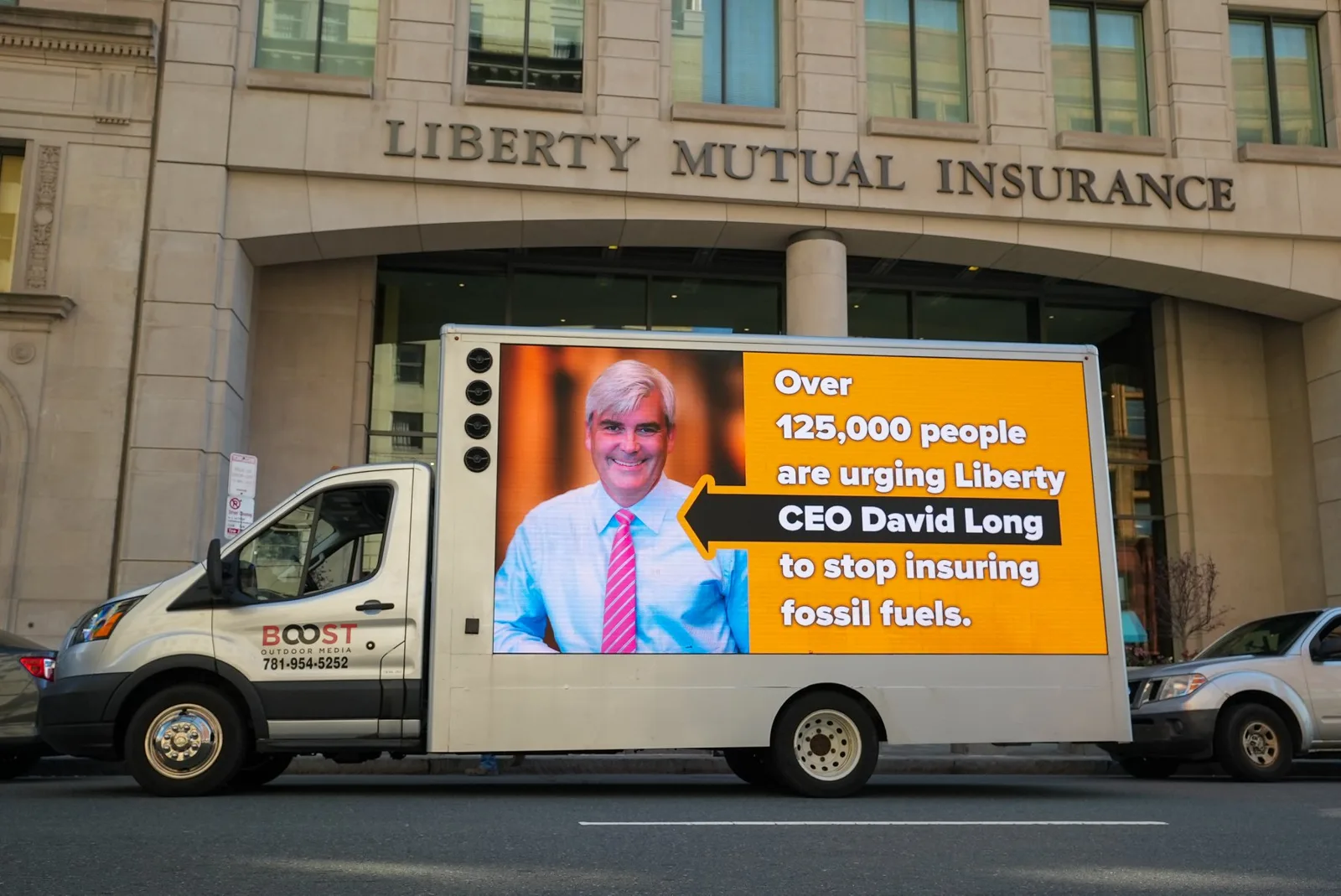
Guerrilla advertising with a mobile LED billboard truck outside a corporate headquarters in Boston.
Guerrilla advertising works because it shows up where the target audience does not expect it — and where the target itself cannot look away. For climate and environmental nonprofits, few tactics put a message in front of a corporate headquarters, a shareholder meeting, or a downtown lunch crowd as directly as a mobile LED billboard truck.
Why insurance became a climate pressure point
Rainforest Action Network and allied groups have spent years making a simple argument: no new coal, oil, or gas project gets built without insurance. That makes insurers a leverage point, and it is why Boston-based Liberty Mutual has been the subject of sustained public campaigning — including a guerrilla advertising campaign RAN ran across Boston that spoofed the company's own consumer advertising from Back Bay to Fenway Park.
The strategic insight behind that work applies to any advocacy group: a company that spends hundreds of millions of dollars a year telling its own story is vulnerable to a counter-message placed in the same physical space its customers, employees, and executives move through every day.
Where mobile LED billboards fit in a guerrilla campaign
Wheatpasting and shelter takeovers are fixed and removable. A mobile LED billboard truck is neither. It is a legal, permitted vehicle on public roads carrying a large digital screen, and it goes exactly where the campaign plan says it should go:
- Corporate headquarters. Loop the building during arrival, lunch, and departure windows so the message reaches employees and executives, not just passersby.
- Shareholder and board meetings. Time routing to the meeting window and the hotels and garages attendees use.
- Industry conferences. Circle the convention center entrance while the target audience is concentrated in one block.
- Legislative buildings. Pair a corporate target with the State House or a district office when a bill or a regulator is in play.
- Campuses and transit hubs. Reach the student organizers and commuters who amplify the campaign on social media.
Five reasons nonprofits choose LED trucks over static out-of-home
- Same-day creative changes. Digital screens mean no printing, posting, or lead time. When a company issues a statement in the morning, the response can be on the street that afternoon.
- No landlord veto. Billboard owners and transit agencies routinely reject advocacy creative. A truck you book directly does not go through that approval gauntlet.
- Address-level targeting. You are not buying a zone. You are buying passes by a specific door at a specific hour, with GPS proof of every loop.
- Built-in content. The truck photographs well. Most advocacy clients get more value from the photos and video than from the raw impressions, because the images fuel press outreach and social channels.
- Fast to launch. A focused city campaign can be routed, designed, and on the road in days — the pace advocacy moments actually move at.
What a one-day corporate accountability route looks like
A typical eight-hour activation in a market like Boston runs roughly like this:
- 7:00–9:30 a.m. Repeated loops of the headquarters block during employee arrival, plus the nearest commuter rail and subway entrance.
- 9:30 a.m.–12:00 p.m. Downtown financial district circuit, hitting the offices of allied targets — brokers, banks, and law firms tied to the same projects.
- 12:00–2:00 p.m. Lunch-hour pedestrian corridors and any plaza where a rally or press availability is staged.
- 2:00–4:00 p.m. Campus and neighborhood loops to reach organizers and supporters.
- 4:00–6:00 p.m. Return to the headquarters for departure traffic and evening rush arterials.
One truck covers all of it. Multi-truck convoys make sense for a coordinated day of action across several targets, but most nonprofit budgets get more out of a single truck running more days.
Creative rules for advocacy campaigns
A moving screen gets about three seconds of attention. That constrains the creative in useful ways:
- One idea per frame. Name the company, name the harm, make one ask.
- Type big enough to read from a crosswalk — headline text, not body copy.
- High contrast. LED renders brightest with bold color blocks and clean sans-serif type.
- Put the organization's name and a short URL or handle on every frame so the photo works as an asset on its own.
- Keep claims documented. Advocacy creative gets scrutinized, so cite what you can stand behind.
Measuring an advocacy campaign
Impressions matter, but they are rarely the point. Track the metrics tied to the campaign's actual theory of change: GPS-verified passes of the target address, hours on route during decision-maker windows, earned media placements that use the campaign photo, social reach on truck imagery, petition or action signups during the activation window, and any direct response from the target organization.
Working with us
Boost Outdoor Media runs mobile LED billboard trucks for nonprofits, unions, and advocacy coalitions across Boston, Providence, New Jersey, New York, and markets throughout the Northeast. We handle routing, permitting questions, creative sizing, and GPS reporting, and we can turn a campaign around quickly when the news cycle demands it.
Related reading: a nonprofit advocacy campaign in Providence and advocacy routing around a congressional district office. Serving Boston and the wider Northeast market network.
Frequently asked questions
Can a nonprofit run a mobile billboard outside a company headquarters?
Yes. The truck operates on public roads and follows the same traffic and parking rules as any vehicle, so routes can loop a specific building on a set cadence during business hours.
Will a billboard company reject our advocacy creative?
Traditional billboard and transit owners frequently decline advocacy and issue-based creative. Booking a mobile LED truck directly avoids that approval process, which is a main reason campaign groups use them.
How fast can a guerrilla campaign launch?
Digital screens need no printing or posting cycle. With approved artwork, a focused city campaign can be routed and on the road within days, and creative can be swapped the same day it changes.
How many trucks does a corporate accountability campaign need?
One truck usually covers a single-city campaign, including the headquarters, downtown, a campus corridor, and rush-hour arterials in the same day. Multi-truck convoys make sense for coordinated national days of action.
What should we measure?
GPS-verified passes of the target address, hours on route during decision-maker windows, earned media pickup, social reach on campaign photos, and actions or signups during the activation.