
How Emergency Rooms Use LED Billboard Trucks to Broadcast Live ER Wait Times
A 324,000-impression mobile LED billboard case study for the Seabrook Freestanding Emergency Room
Emergency departments compete for a decision that happens in under 60 seconds. When someone sprains an ankle at a soccer game or a parent decides a fever has gone too far, they don't research hospitals — they go to the ER they can picture, the one they believe will see them fastest. That's exactly the moment a mobile LED billboard wins.
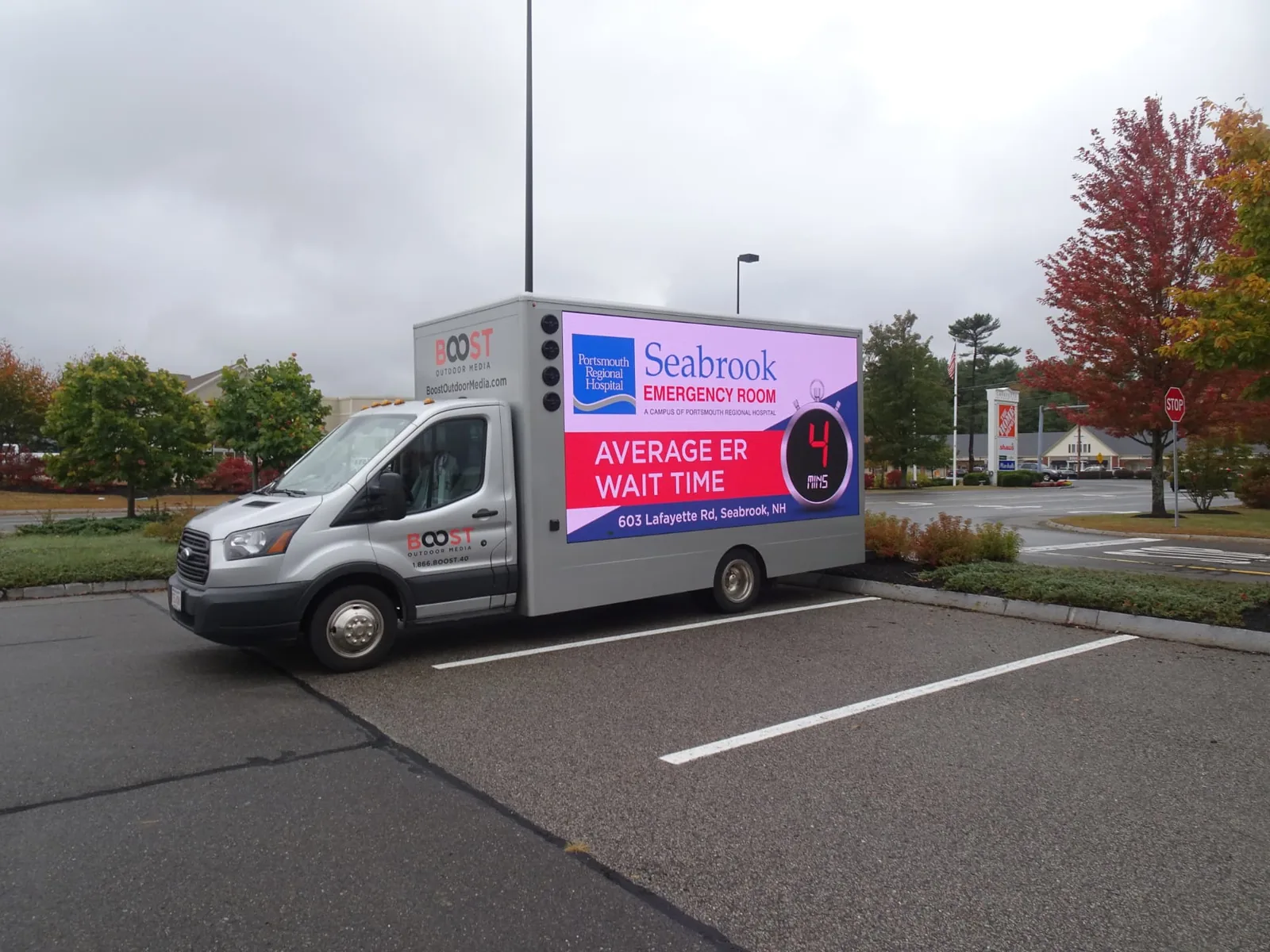
Boost Outdoor Media ran a mobile LED billboard truck campaign for HCA's Seabrook Freestanding Emergency Room, a campus of Portsmouth Regional Hospital in Seabrook, NH. The creative did something most healthcare advertising can't: it displayed the live average ER wait time, updated from the hospital's own feed, on a 3-screen LED truck driving the exact roads local patients use every day.
Campaign snapshot: Seabrook FSER
- Client: HCA Healthcare — Seabrook Emergency Room (campus of Portsmouth Regional Hospital)
- Days of activation: 12 | Contracted hours: 96
- Total estimated impressions: 324,196
- Total ad plays delivered: 63,482 (split almost evenly between the static brand ad and the live wait-time ad)
- Towns covered: Seabrook, North Hampton, Hampton, Hampton Falls, Amesbury, Salisbury, Newburyport, Haverhill, Merrimac, Salem
Why "wait time" is the strongest message an ER can run
Hospital marketing teams spend heavily on brand equity — quality scores, physician credentials, community trust. All of it matters. But at the moment of need, patients optimize for one variable: how long will I sit there? National data consistently shows median ER wait times measured in tens of minutes to hours. A freestanding emergency room that can honestly display a 3-, 4-, or 6-minute average wait holds an enormous competitive advantage — if the public knows about it.
A static billboard can't say "4 minutes." A radio spot can't either. A mobile LED billboard truck can, because the screen is a live digital display fed by real-time data. That single capability turns an awareness ad into a call to action with a number attached.
The creative rotation that worked
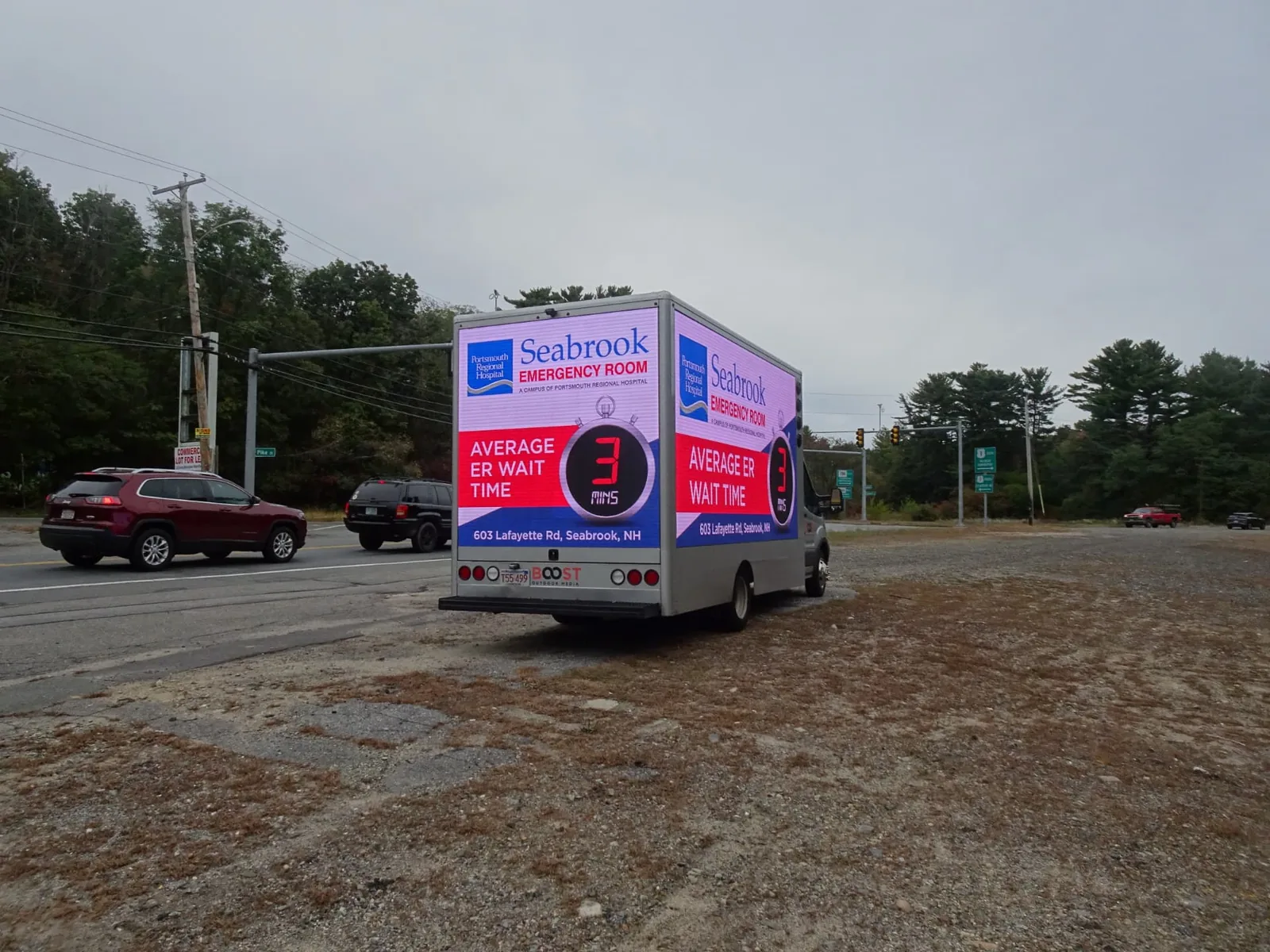
The Seabrook campaign alternated two looped creatives across the two side screens and the rear screen:
- Brand + access ad: "24/7/365 — Fast Expert ER Care," logo lockup, and the street address, 603 Lafayette Rd, Seabrook, NH.
- Dynamic wait-time ad: "AVERAGE ER WAIT TIME — [live number] MINS," pulled from the hospital's wait-time RSS feed, plus the same address.
The pairing matters. The dynamic ad creates urgency and proof; the static ad supplies the brand and the destination. Running only the number would win attention without teaching people who and where. Running only the brand ad would be ordinary outdoor advertising.
Routing: get in front of patients before they need you
Emergency room advertising is a geographic memory game. You are not converting today's impression into today's visit; you are installing a default answer for the day something goes wrong. That makes route strategy more important than raw reach.
The Seabrook plan concentrated on:
- Shopping centers and grocery anchors within the primary service area — where families circulate on weekends
- Business parks during shift changes
- Rush-hour arterials — the main commuting avenues where the same drivers pass the truck repeatedly, building frequency
- The corridor around the FSER itself, reinforcing physical proximity to the facility
The impression-share data reflects that discipline. Seabrook itself accounted for 32% of impressions in Week 1, rising to 44%, 40%, and 46% in Weeks 2–4, with North Hampton, Amesbury, Hampton, and Salisbury filling the surrounding ring. That's a campaign anchored to the service area, not scattered across a media market.
What emergency centers should take from this
1. Freestanding ERs have a distribution problem, not a quality problem
A new FSER can be clinically excellent and still be invisible for 18 months. Residents already have a hospital in their head. Mobile billboards drive through the neighborhoods that feed the facility and replace that default with a closer, faster option.
2. Real-time data beats adjectives
"Short waits" is a claim. "4 MINS" is evidence. If your hospital publishes wait times to a website or feed, that feed can drive the LED creative directly — the same integration used here.
3. Always pair the number with the address
Every frame in this campaign carried "603 Lafayette Rd, Seabrook, NH." Emergency care is hyper-local; the address is the offer.
4. Use it for seasonal and service-line surges
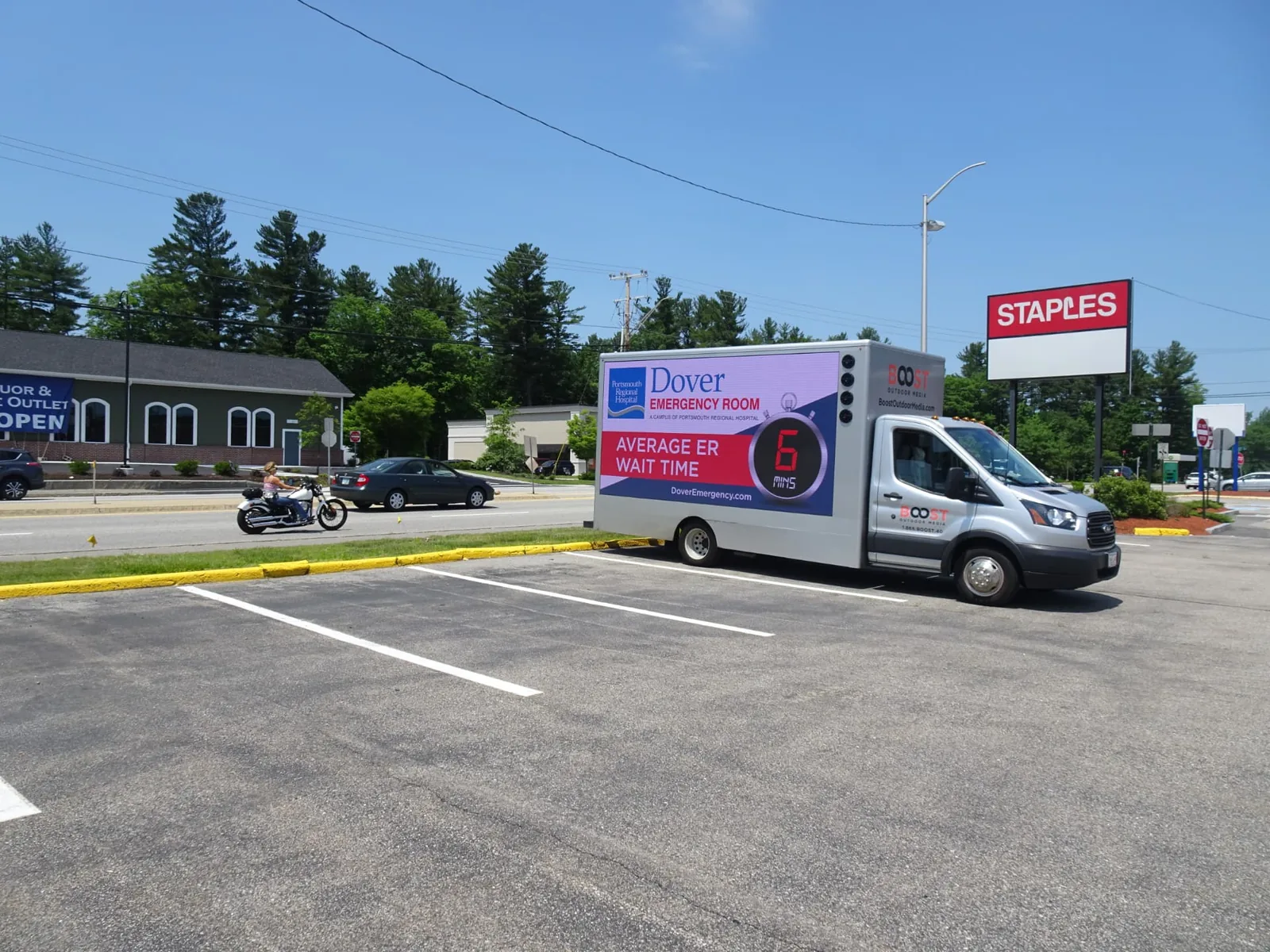
Flu season, summer tourist influx at beach communities, back-to-school sports injuries, holiday weekends, and new urgent-care or pediatric-ER launches are all natural flight windows. Boost has run the same playbook for the Dover Emergency Room campus as well.
5. Report on impressions and geography
Ask your vendor for impression share by town, day-by-day delivery, and ad-play counts per creative. Hospital marketing committees approve renewals on documented coverage of the service area, not a photo of a truck.
How to build an ER mobile billboard campaign
- Define the catchment. List the 6–12 towns that should be feeding your ED, weighted by drive time.
- Decide the proof point. Live wait time, door-to-doc time, 24/7/365 access, or a new service line.
- Connect the feed. If wait times are published, we integrate the feed so the LED creative updates automatically.
- Design for 4 seconds. Logo, one number, one address. Nothing else survives at 35 mph.
- Schedule around behavior. Weekday rush hours, weekend retail peaks, event traffic.
- Run 3–4 weeks minimum. Frequency is what converts an ad into a default.
- Measure by town. Rebalance the route weekly based on impression share.
Compliance note for healthcare marketers
Mobile LED billboards for emergency departments carry no patient data and no PHI — the only dynamic element is a facility-level operational metric your hospital already publishes. Keep the displayed figure sourced from the official feed, label it clearly as an average, and the creative stays consistent with what's on your website.
Bring it to your market
If you run a hospital emergency department, a freestanding ER, or an urgent care network, a mobile LED billboard truck puts your wait time, your brand, and your address directly on the roads your patients already drive. Boost Outdoor Media operates across New England and nationwide — see our markets, review mobile LED billboard advertising, or request a quote.
Frequently asked questions
Can a hospital display real-time ER wait times on a mobile billboard?
Yes. If the hospital publishes average wait times to a website or data feed, that feed can drive the LED creative so the displayed number updates automatically while the truck is on route. The Seabrook Emergency Room campaign alternated a live wait-time ad with a static brand ad on all three screens.
Is ER wait time advertising HIPAA compliant?
Mobile LED billboard creative for an emergency department carries no patient data or PHI. The only dynamic element is a facility-level operational metric the hospital already publishes. Source the figure from the official feed and label it clearly as an average.
How many impressions can a hospital mobile billboard campaign deliver?
The Seabrook freestanding ER campaign delivered 324,196 estimated impressions and 63,482 ad plays over 12 activation days and 96 contracted hours across ten towns.
How long should an emergency room mobile billboard campaign run?
Plan for at least three to four weeks. Emergency room advertising works by frequency: you are installing a default answer for the day something goes wrong, so repeated exposure along commuting routes matters more than one-time reach.
What should ER mobile billboard creative include?
A logo lockup, one number (live wait time or door-to-doc time), and the street address. Anything more will not read at 35 mph.
Does this work for urgent care and freestanding ERs too?
Yes. Freestanding ERs and new urgent care locations benefit most, because their challenge is distribution and awareness inside a tight catchment rather than clinical quality.