
Church Advertising with LED Billboard Trucks: A Nationwide Outreach Guide
How churches, ministries, and faith-based organizations can promote services, revivals, conferences, and community events in any U.S. market
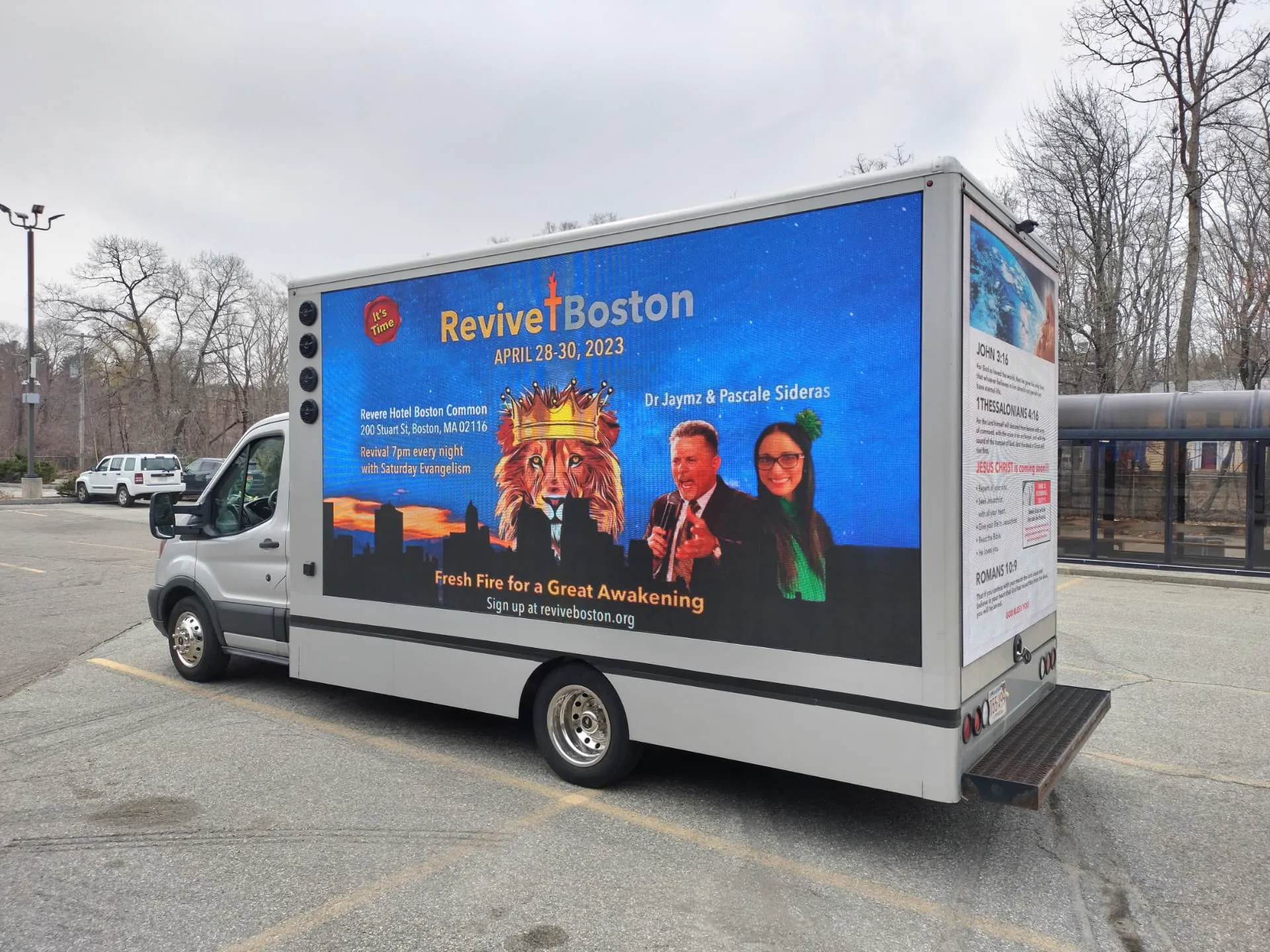
A mobile LED billboard truck promoting a Revive Boston faith event with dates, speakers, and venue details.
Church advertising with LED billboard trucks brings a clear invitation directly into the neighborhoods a ministry wants to reach. Although the campaigns pictured here ran in the Boston and Worcester, Massachusetts areas, the same mobile strategy can promote worship services, revivals, conferences, holiday programs, youth events, and community outreach anywhere in the United States.
Unlike a fixed sign, a mobile LED billboard can follow planned routes through several neighborhoods in one day. Churches can place a service time, event date, location, speaker, website, or simple call to action in front of commuters, families, students, and local residents near the places they already visit.
How Mobile Church Advertising Works
A church LED billboard campaign combines a bright digital message with a route built around the audience and event. The truck can circulate near shopping districts, commuter roads, community centers, campuses, residential corridors, and the venue itself at the times those areas are busiest.
A Revive Boston faith-event campaign uses a large roadside LED display to promote dates, speakers, location, and a clear invitation.
Effective church advertising is easy to understand in a few seconds. The strongest creative usually includes one central message, a readable event name, a short date and time, the church or venue name, and one next step. A short web address or QR code can support the message, but it should not replace large, readable event information.
Church Events an LED Billboard Truck Can Promote
Mobile billboard advertising can support both recurring services and time-sensitive church events. It is especially useful when a ministry needs broad local awareness within a defined period or wants to reach several communities without buying separate fixed signs.
- Sunday services and new church launches: Introduce a congregation, service schedule, and location to nearby residents.
- Revivals and worship nights: Promote dates, featured speakers, musicians, and registration information.
- Easter and Christmas services: Build visibility during high-interest seasons when people may be actively looking for a church.
- Conferences and conventions: Reach attendees near hotels, airports, convention centers, restaurants, and the host venue.
- Youth and family events: Promote vacation Bible school, concerts, camps, school-supply drives, and family festivals.
- Community outreach: Publicize food distributions, health clinics, support programs, volunteer drives, and neighborhood events.
- Fundraisers and building campaigns: Raise awareness for a specific goal while directing supporters to a concise landing page.
Local Church Outreach in Boston and Worcester
Boston-area church campaigns can connect city neighborhoods, suburban communities, college populations, and regional visitors through one coordinated route. The photographs in this case study show how the same format works for both large revival messaging and a direct invitation to a local church service.
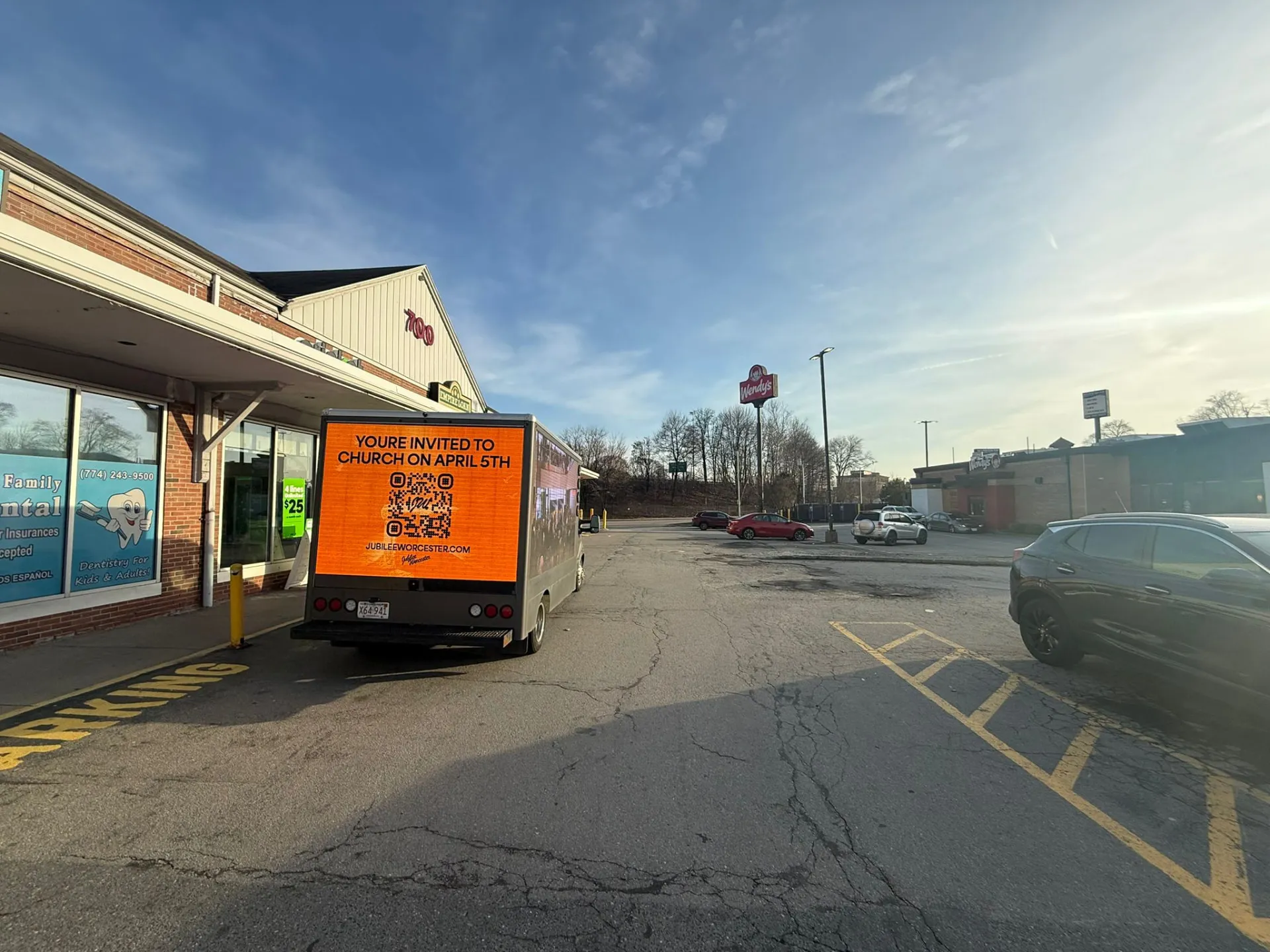
A church invitation travels through a Worcester retail corridor where residents can see the date and scan the campaign response code.
In Greater Boston, potential routes may connect downtown activity, transit corridors, university areas, neighborhood business districts, and the church venue. In Worcester County, routes can focus on retail centers, local commercial roads, downtown destinations, schools, and residential connectors. The exact route should reflect the congregation's real service area rather than simply covering the most miles.
Nationwide Church and Ministry Campaigns
The same church advertising plan can be launched in one city or coordinated across multiple U.S. markets. A national ministry can use consistent creative while adapting routes, event details, and calls to action for each city.
Nationwide church advertising may be useful for a touring ministry, multi-city revival, denominational conference, church-plant launch, faith-based film, worship tour, or coordinated holiday outreach. Boost Outdoor Media can plan mobile LED billboard routes around churches, arenas, convention centers, campuses, hotels, airports, and community gathering places in the selected markets.
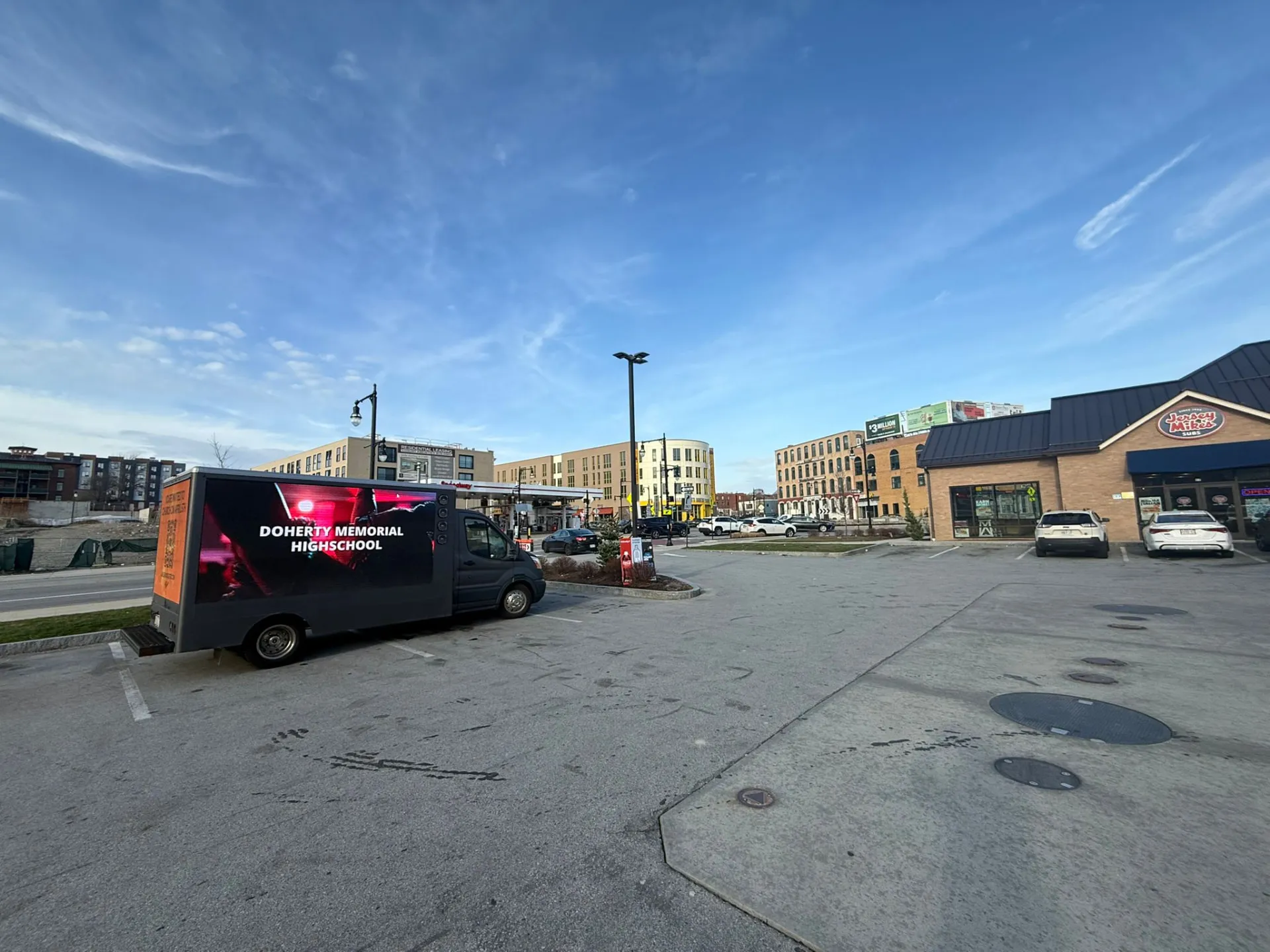
A faith-community event message reaches drivers and pedestrians in a busy Worcester commercial district.
For a multi-market campaign, the core design can stay recognizable while the city, date, venue, and response link change by location. This gives the campaign a consistent identity without making every market feel generic.
Church Recruitment and Community Awareness
Church marketing is not limited to increasing Sunday attendance. A campaign can also recruit volunteers, ministry staff, musicians, teachers, childcare workers, outreach partners, and participants for community programs.
Messages can be tailored to goals such as “Join Our Worship Team,” “Volunteers Needed,” “Free Community Meal,” or “Youth Program Registration Open.” A focused message often performs better than placing every ministry program on one screen. Separate creative can rotate during the route when a church has more than one priority.
Planning the Route and Schedule
A successful route begins with the people the church wants to reach, not a generic list of busy streets. The planning process should identify the event location, congregation radius, nearby towns, community destinations, commute patterns, and the hours when the intended audience is most likely to be present.
- Define one primary goal, such as registrations, attendance, volunteer inquiries, or local awareness.
- Select the cities, neighborhoods, venues, and community corridors that match that goal.
- Choose campaign dates that give people enough time to act while keeping the event timely.
- Create short, high-contrast artwork that remains readable while the truck is moving.
- Use a dedicated page, phone number, or QR code when response measurement is important.
- Review route photos and campaign reporting after the event to inform the next outreach effort.
What Does Church Billboard Advertising Cost?
Boost Outdoor Media's typical mobile LED billboard pricing is approximately $1,200 to $1,400 per truck per day, depending on the market, schedule, route, and campaign requirements. A one-day event push may work for a concentrated local audience, while a longer schedule can build repetition before a major service or conference.
| Campaign type | Typical approach | Best suited for |
|---|---|---|
| Single-day activation | One truck on a concentrated route | Opening day, worship night, conference day |
| Multi-day local campaign | Repeated routes before the event | Holiday services, revivals, church launches |
| Multiple-truck campaign | Simultaneous coverage in separate areas | Large metro areas and regional events |
| Multi-city campaign | Coordinated creative and local routes | National ministries, tours, and conferences |
The most useful budget is the one tied to a defined audience, geography, and outcome. Churches should compare the cost against the number of priority communities reached and the value of the event, rather than choosing a route based only on traffic volume.
Church Advertising Ideas That Help People Respond
The best church campaign gives viewers one clear reason to care and one easy next step. Lead with the event or benefit, keep the design uncluttered, and make the invitation welcoming to someone who may not already know the church.
- Use a short headline such as “Easter Service,” “Community Revival,” or “You Are Invited.”
- Display the date, time, and city in large type.
- Show the church or ministry name consistently across the truck and landing page.
- Choose photographs and colors that remain clear on a bright outdoor screen.
- Use a memorable URL and test every QR code before launch.
- Create separate messages for attendance, volunteer recruitment, and community services.
Plan a Church Outreach Campaign
Boost Outdoor Media plans mobile LED billboard advertising for churches, ministries, conferences, and faith-based organizations in Boston, Worcester, and markets across the country. Explore our mobile LED billboard service, review mobile billboard advertising costs, or request a campaign quote with your city, event date, and outreach goals.
Frequently asked questions
How can a church advertise an upcoming event?
A church can promote an event with a mobile LED billboard truck routed near neighborhoods, retail areas, campuses, commuter roads, and the venue. The message should feature one event, a readable date and time, the church name, and one clear response action.
Do LED billboard trucks work for church outreach outside Boston?
Yes. The Boston and Worcester photos in this article are local examples, but the campaign model can be used in cities across the United States. Routes and creative can be adapted for each market while maintaining a consistent ministry identity.
What church events can mobile billboards promote?
Mobile billboards can promote Sunday services, Easter and Christmas programs, revivals, worship nights, conferences, youth events, church launches, food distributions, volunteer drives, and other community outreach programs.
How much does church billboard advertising cost?
Boost Outdoor Media typically prices mobile LED billboard campaigns at approximately $1,200 to $1,400 per truck per day. Final pricing depends on the city, schedule, route, number of trucks, and campaign requirements.
Can a church run an advertising campaign in several cities?
Yes. A multi-city church campaign can use consistent creative while changing the event date, venue, response link, and route for each location. This approach fits touring ministries, conferences, worship tours, and coordinated national outreach.
What should a church put on an LED billboard?
Use a short invitation, the event name, date, time, city or venue, church name, and one simple call to action. Keep the design high contrast and uncluttered so drivers and pedestrians can understand it quickly.